Make Every Move Count: Custom Systems for Clearer Decisions
Make every move count is a planning idea, not a game. A business move is easier to judge when the records that inform it are already in one view. InterGlobal is a Digital Intelligence Company in Dallas. This guide is about custom business systems: a complex CRM, complete financial tracking, and the operations that connect them. CRM and financial tracking get the same weight. One is not a footnote to the other.
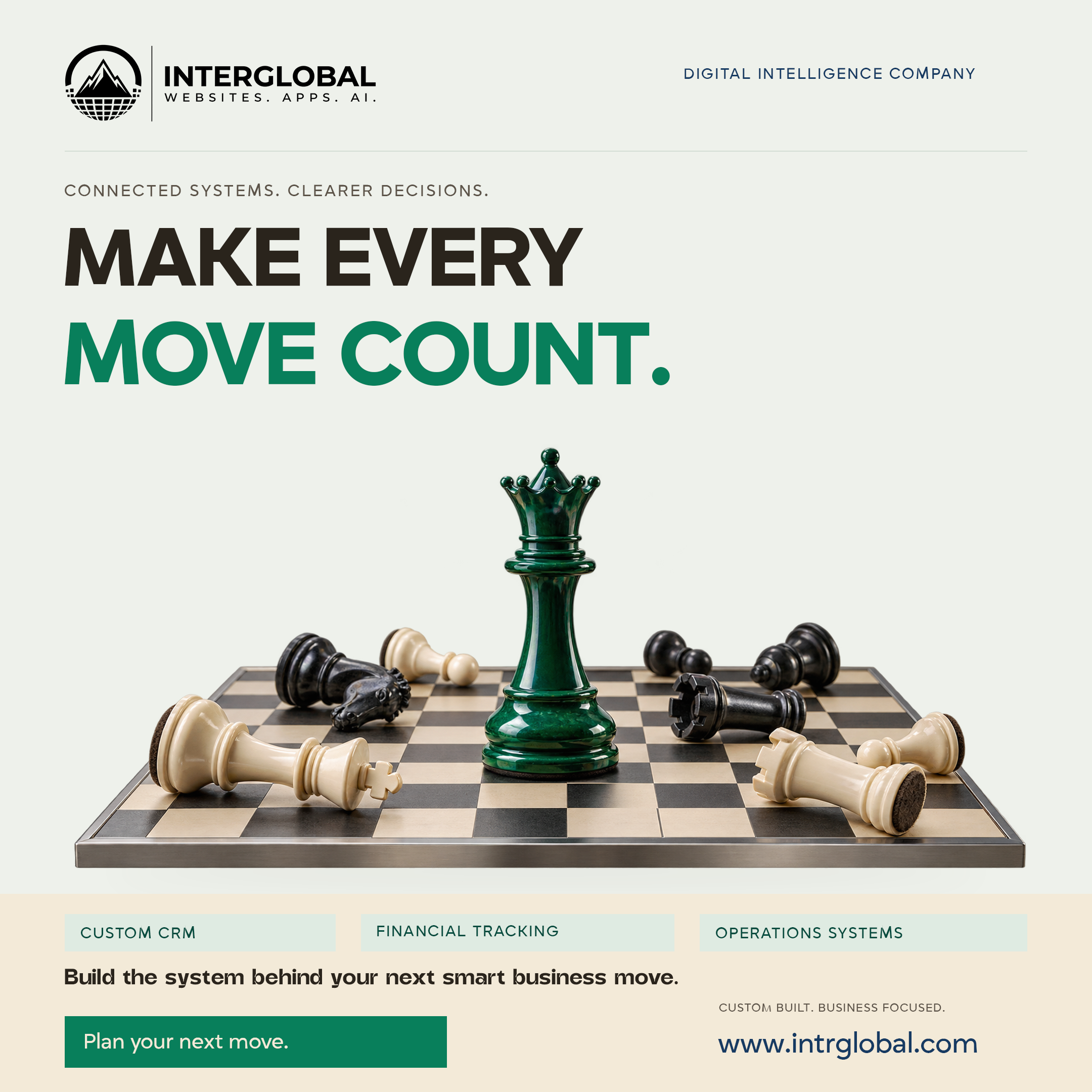
The picture is a working metaphor. A chessboard and its pieces are one artwork. They rest. Nothing lifts, and no piece is asked to act on its own. The board is there so you can see the position before the next step. That is the claim of the film. It is not a match report, a client result, or a product screenshot.
Under the board, three chips sit in one row. Custom CRM. Financial tracking. Operations systems. The support line says to build the system behind the next smart business move. The button says Plan your next move. The address on the poster is www.intrglobal.com.
The square under the film is that same poster, rebuilt from all 21 pieces, on the same 2160 by 2160 canvas. It is not a second copy of the video. Replay runs the entrance once, then holds the poster. If you prefer less motion, the finished poster appears at once. The button and the website stay real links either way.
Quick answer: Decide the next business action from records you can already see. A custom CRM holds the customer path. Financial tracking holds income, expenses, and cash flow. Operations carry the tasks, the handoffs, and the reporting between them.
- Name the customer path and the money path as two equal jobs.
- Ask what the business needs to do next, before you ask which tool comes next.
- Connect a handoff only where a person already walks it.
What's in this article?
What you can see before the move
Every business move depends on what you can see before you make it. The sentence is ordinary on purpose. A person who can see the customer, the money, and the work in progress can choose a next step. A person who has to assemble those three from memory is guessing, even when the guess is experienced.
Seeing is not the same as collecting more software. A new login can hide the same split behind a new screen. The useful view is the one a specific person opens before a specific decision. If that person still exports, retypes, and asks in chat, the view is not there yet. The film starts on the board for that reason. The position is visible. The next move is still a choice.
The artwork stays one scene. The board, the standing piece, and the pieces at rest are a single image. The film moves that image together, a small amount, then puts it back. It does not invent a separate motion for any piece. A system should work the same way: the parts you show belong to one picture of the work.
When the records live apart
When customer records, financial information, and daily work live apart, the next step gets harder to judge. Each pile can be tidy on its own. The customer list is current. The sheet of income and expenses is current. The task list is current. The decision still waits, because the decision needs all three, and no one place holds them.
The film shows that split as three labels. Customers. Finances. Work. Short rules between them stop on purpose. They do not pretend the piles are already one system. People carry the missing piece. That carrying is reasonable while the business is small. It becomes the system itself when it is the only way a decision gets made.
Apart
Three honest piles. The path between them stops. Someone remembers the link, or the link does not happen that day.
Connected
The same three jobs stay named. A path is drawn only after you can say what moves, who receives it, and what done looks like.
Start with a system that connects the information the business needs. That is a scope sentence, not a catalog. The information is the customer path, the money path, and the handoffs your team already makes. Anything else can wait.
A custom CRM
A custom CRM can bring leads, customer history, and follow-ups into a clearer customer journey. CRM here means that journey. A lead comes in. The lead becomes a customer. Someone follows up. The chip on the poster names the job. The film draws the path as three words in a row: Lead, Customer, Follow-up. There is no named contact, no score, and no sample screen.
1. Lead
Where a name first lands. One place. If three inboxes all claim to be first, the journey has not started.
2. Customer
What you know once the work is real. History sits on the record people already open.
3. Follow-up
The next action, with a person. A record without a next action is a list.
Complex means the business is complex. More than one service. More than one person on the same customer. A status that sales and delivery both need. Custom means the fields and the path match that work. It does not mean a famous product with a new logo. App development is how the path gets built. The spec is still a sentence: who looks at this record, and what they do next.
This is a proposed capability, not a deployed product. The article does not claim a CRM is already running for a named client, and it does not claim a change in close rate. If a sentence needs a number this studio has not published, the sentence does not belong here.
Financial tracking
Financial tracking can organize income, expenses, and cash flow so the business picture is easier to review. This is the same kind of job as the CRM, on the money side, and it gets the same size chip. Income. Expenses. Cash flow. The film gives those three words the same row, the same weight, and the same refusal to invent a figure.
1. Income
What came in, tied to the work that earned it. If the payment cannot find the customer record, the two systems are still apart.
2. Expenses
What went out, in categories the business already uses. A new set of labels that the person who pays the bills does not recognize is not a clearer picture.
3. Cash flow
The order of those movements. Visibility, not a forecast to bet the company on, and not tax advice.
Complete, in this guide, means designed with the same seriousness as the CRM. Teams often fund the customer tool and leave the money view as a weekly export. That choice keeps the original split. A complete financial tracking platform, as this campaign uses the phrase, is the place where income, expenses, and cash flow can be reviewed together. It is not a bank connection, not payment processing, not a published balance, and not a tax filing. Those are separate decisions.
Do not draw a number you were not given. A chart with a made-up total would make the poster look finished and the decision worse. The film leaves the figures out. The review still has a place to happen once your own records are in it.
The two paths meet at events you can name. A job is agreed. An invoice goes out. A payment lands. If those three cannot point at one another, a person is still the system. Building the CRM and the financial view together is how that person gets the picture before the next move.
Connected operations
Operations tools can connect tasks, reporting, and the handoffs between your team. The third chip is not a third company. It is the work that carries a customer record and a money record from one person to the next. The film draws that path as Task, Handoff, and Report. A small mark travels along the route, under the words, and then leaves. It does not pass through the board.
1. Task
The unit of work a person can finish. If the task is still a mood, it is not ready to be a field.
2. Handoff
Who receives it, and in what form. A handoff you cannot walk stays a short line, the way the opening of the film keeps its rules short.
3. Report
What done looks like to the person who reads it. A report no one opens is not a connection.
Connected records support clearer decisions, with room for the system to evolve. Room to evolve means a field, a path, or a report can change when the offer changes. It does not mean the business will grow, and it does not mean every future tool is included. You own what gets built. The test is who can change it later.
AI integrations fit a step that already repeats and already has a before and an after. They do not invent the records, the categories, or a result. If the handoff is still being discovered, automation only moves the confusion faster.
The useful question
The useful question is not which tool comes next, but what your business needs to do next. The film asks it in plain words: What should happen next? Three answers sit in a row. Follow up. Review cash flow. Move work forward. Each answer points at a chip that is already on the poster. The question is a way to choose. It is not a quiz score.
Follow up
The customer path has a next action, and a person owns it. If you cannot name the action, the CRM is not the next build. The missing sentence is.
Review cash flow
The money path can be read without rebuilding a sheet. Income, expenses, and timing, in categories you already trust.
Move work forward
A task has a handoff and a report. Someone besides the person who did the work can see that it happened.
InterGlobal creates custom systems around that work, from complex CRMs to complete financial tracking platforms. The range is the work in this guide. It is not a menu of unnamed integrations. A related note on building from the way the business already runs is unlock your business systems. A note on giving a stalled idea one next step is give your idea momentum.
Bring the last ten real jobs. For each one, write the customer fact you looked up, the money fact you checked, and the handoff that followed. Patterns in those ten are a better brief than a feature list copied from a product page.
The poster, in motion
Replay walks the 21 pieces in groups, then holds. The sage field is already there. The logo, the company line, and the header rule come in first. The kicker and Make every arrive with the chess scene. That scene is one image. It settles from a small lift, no more than 20 pixels, and a scale of 1.02, back to exactly 1. The shadow follows on the vertical only. Its softness is already in the file. Then Move count appears in the campaign green, as type, not as a glow. The CRM chip and its label arrive together, then financial tracking, then operations. The paper footer, the support line, the button, and www.intrglobal.com settle last. The square holds the poster. It does not loop.





















Want the next move checked against the records you already keep?
Book a call. We will talk through the customer path, the money path, and the handoff between them.
Plan your next move.Emerald and sage on this poster are campaign colors for this picture. They do not replace the studio palette. The logo, the type, and the address stay InterGlobal. The written address is www.intrglobal.com.
This week
Key takeaways
- A next move is easier when customer records, financial records, and daily work can be seen together.
- A custom CRM is the customer journey. Financial tracking is income, expenses, and cash flow. They are equal jobs.
- Operations connect a task, a handoff, and a report only where that path already exists.
- Plan your next move opens the booking section. www.intrglobal.com is the address.
Questions before the call
Why a chessboard?
You look at the position before you choose a move. The board and the pieces are one image. They rest. The picture is not a match, a victory, or a claim that a business will win.
Why are CRM and financial tracking the same kind of chip?
They are equal parts of the decision. A customer path without the money path, or the reverse, leaves someone connecting the pieces by hand.
Is this accounting or tax software?
No. Financial tracking here means a clearer review of income, expenses, and cash flow. It is not tax advice, a bank connection, payment processing, or a published balance.
Will this plug into the tools we already use?
Only where a handoff already exists and you can name it. This article does not claim a list of integrations.
What does the button do?
Plan your next move opens the booking section at https://intrglobal.com/#book. www.intrglobal.com opens the studio site.
Why is there a square and a video?
The video is the narrated film. The square is the same design rebuilt from its 21 pieces, so you can replay the sequence without playing the film.
What if I prefer less motion?
The poster appears complete, and both links still work. Replay stays available when motion is allowed.
How do I start?
Use the button on the poster or the one under it. Both go to the booking section. You can also call (972) 314-4419.
Plan your next move.
That is the line on the poster. It opens the booking section, and www.intrglobal.com stays the address.
Plan your next move.