Give Your Idea Momentum: A Practical Way Forward
Give your idea momentum means giving a good idea a practical way to move. InterGlobal is a Digital Intelligence Company in Dallas. We build websites, custom apps, and AI systems that work together. This guide is for an owner who already has the idea and needs the next useful step, not a faster version of the same stall.
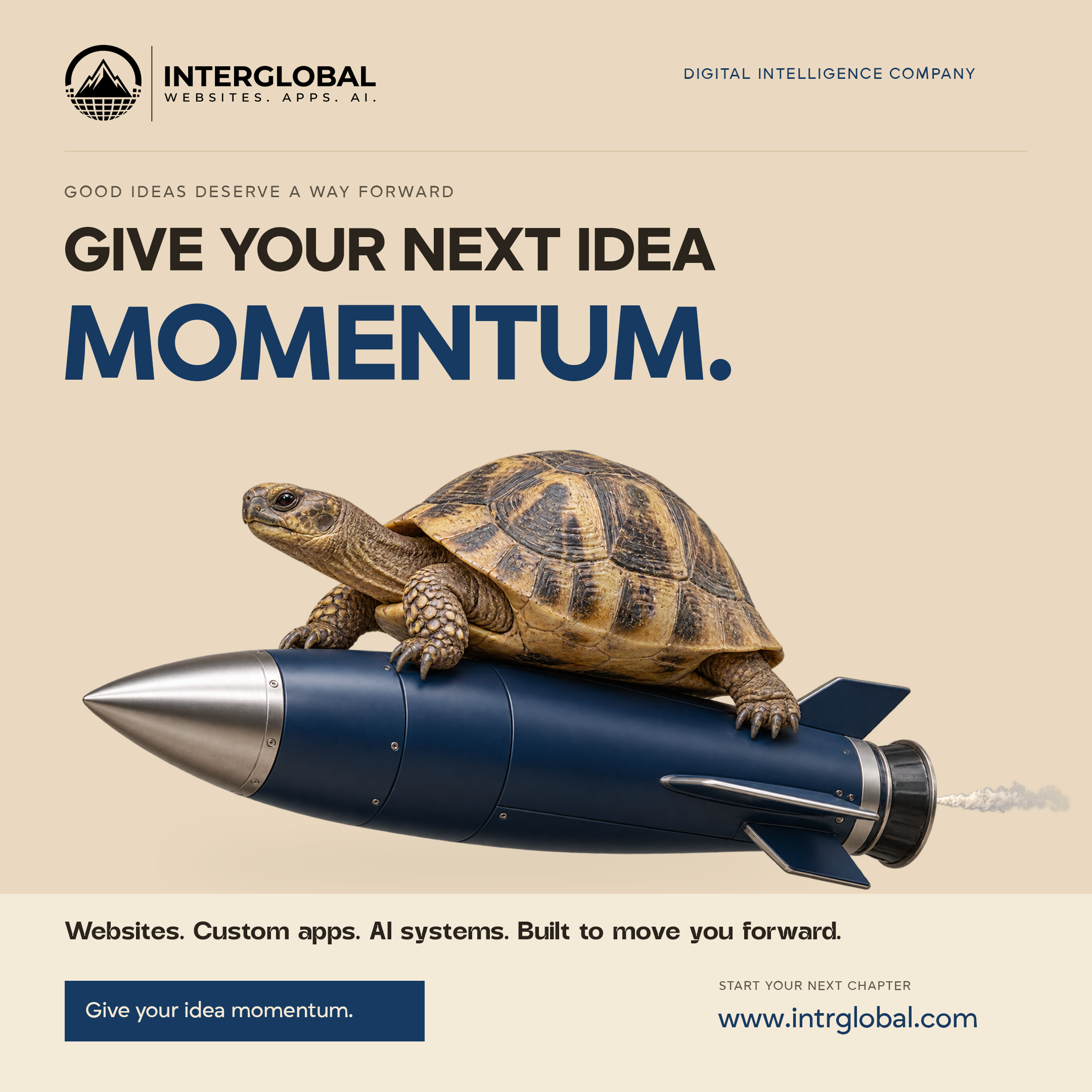
The picture is a metaphor, not a client result and not a launch. A tortoise sits on a navy civilian rocket. The tortoise and the rocket are one piece of artwork. They do not separate, and the animal is not animated. A small vapor trail stays attached to the nozzle. The point is direction. A careful idea can still move when the work behind it has somewhere to go. More speed, by itself, is not the answer. The poster does not promise growth, a ranking, or a military image. It promises a system that can carry the idea forward.
The square under the film is the same poster, rebuilt from all 16 pieces of the design, on the same 2160 by 2160 canvas. It is not a second copy of the video. Replay runs the entrance once, then holds the finished poster. If you prefer less motion, the complete poster appears at once. The button and www.intrglobal.com are real links either way.
Quick answer: Momentum is a clear next step, supported by a website, the work behind that website, and AI only where a routine task already exists.
- Name the next useful thing a customer should be able to do.
- Put that step on a page that explains the offer.
- Build custom apps and AI around work you already do, and keep ownership of what is built.
What's in this article?
What momentum is
Speed is not the whole answer
A good idea can move slowly when the work behind it has nowhere to go. The stall usually looks like activity. A new post, a new tool, a new page that still asks the visitor to figure out the offer. People notice the idea and then wait, because the next action is not named. Adding speed to that wait does not create a direction. It shortens the time between the same two dead ends.
Direction is a sentence you can point at. What should the customer do next, on this visit, with the information they have? If the answer is "learn more," "explore," or "see why we are different," the idea is still sitting still. A direction names a real action: book, call, request the thing you actually sell, or check a status you already track. The kicker on the poster says the same thing in fewer words: good ideas deserve a way forward.
Why the picture is a tortoise
The tortoise is the idea. The rocket is the system that carries it. They stay in contact. The vapor stays on the nozzle, because a trail that floats away from the engine is decoration, not thrust. None of that is a claim about how fast a business will grow. It is a way to see the difference between an idea that is careful and an idea that is stuck. Careful can still move. Stuck has no route.
The company line is Digital Intelligence Company. That is the category, not a feature list. The work under it is websites, custom apps, and AI systems treated as one system. The support line on the poster says it plainly: built to move you forward. The address on the poster is www.intrglobal.com.
The next useful thing
Start by defining the next useful thing your customer should be able to do. Write it as a verb and an object, in the customer's words. "Book a 20-minute call." "Request a quote for this service." "See whether the job is in progress." If you need a paragraph to explain the verb, the step is still an internal process, not a customer action.
Test the sentence on the work you already do. Open the last ten conversations with a real customer. What did they ask for at the end? If the same request shows up, that request is the next step. If every conversation ends somewhere different, you do not have a momentum problem. You have an offer that has not been chosen yet. A website cannot pick the offer for you, and an app cannot either.
One next step is enough for the first screen. A second step can live further down the page. A third step that competes with the first one puts the idea back where it started.
A website that explains the offer
Build a website that explains the offer and makes that next step easy to find. That is the job of web design here. The first screen should survive being read out loud to someone who does not work with you. Offer, then next step, then the action. The route is short on purpose. A visitor should not have to reconstruct your services from a menu, a slider, and a paragraph about passion.
A Next.js website fits when the site has to stay fast and hold more than a brochure. It is the right build when the page, the booking path, and later software need to share one front door. It is the wrong reason to rebuild if the current page already explains the offer and the only problem is that nobody is maintaining it. Say which of those is true before you commission the rebuild.
Say the place when the place is true. The Dallas web design page is how this studio names its own city. One honest location is clearer than a footer full of cities you do not serve. Cost is a separate question. The notes on Dallas website prices and what a cheap site actually costs stay on those pages. This one does not set a number.
Keep the address readable. The poster shows www.intrglobal.com because a person should be able to type it. The words link to intrglobal.com.
A page that stalls
The headline is a mood. The next control says "learn more." The offer is a list of capabilities with no order. A visitor can admire it and still not know what to do.
A page that moves
The headline names the work. One control does the next useful thing. The rest of the page supports that step instead of competing with it.
The poster, in motion
Replay walks the 16 pieces in order, then holds. The cream field is already there. The real logo, the company line, and the header rule come in first. The tortoise and the rocket arrive as one artwork, with a short drift back into place. The vapor rides with the nozzle and eases back to its drawn shape. The ground shadow follows the horizontal move and stays on the ground. Then the kicker and the two headline lines appear: Give your next idea, then Momentum. The footer, the support line, the button, and the website settle last. From there the square holds the supplied composition. It does not keep breathing.
















Want the next step checked against the page you have?
Book a call. We will tell you whether the next move is the page, the system behind it, or a routine task that can be connected.
Give your idea momentum.Apps around the business
Bring the work behind the page into custom apps shaped around your business. A status a client can check. A handoff between two people who currently forward the same email. A request that should land in one place instead of three inboxes. App development builds that around the job. An MVP is the smallest version of that job you can put in front of the people who already do it. It is not a second homepage, and it is not a reason to hide a weak offer behind a login.
Name the repeated job in one sentence before you name the app. "We need an app" is not a spec. "A customer can see the next step without emailing us" is a spec. If you cannot write that sentence, go back to the page. Two related notes use the same order, page then system: break out of ordinary, built to be remembered, and turn attention into connection.
1. The offer
Say what you sell in the words a customer already uses. If the sentence only makes sense inside the company, it is not ready for a page or an app.
2. The handoff
Write down who receives the request and what they do with it. An app is justified when that handoff already happens and keeps breaking.
3. The status
If people ask "where is this?" more than once a week, the answer belongs somewhere they can open. That is a product decision, not a chat habit.
AI where it helps
Use AI integrations where they help handle the routine tasks that get in the way. A draft from notes you already took. A sort of requests that already have categories. A route from a form to the person who already owns that kind of job. AI integrations sit on a step that already happens. They do not invent the offer, the city, or a result you have not earned.
A routine task has a before and an after. Before: the same kind of message arrives. After: a person files it, answers it, or sends it on. If you cannot describe both sides, there is nothing for a system to follow. Connecting a vague page to a faster tool makes the stall arrive sooner. The assistant will answer in whatever voice the page already has.
Do not automate a step you have not chosen. If the next customer action is still "learn more," an integration will only produce more ways to say "learn more."
You own what we build
You own what we build, and it can evolve as the business grows. That is a service proposition, not a measured result and not a license claim about someone else's software. The point is practical. The website, the app, and the connections should be yours to change when the offer changes. A stack you cannot steer turns the next idea into another stall, because every change waits on a vendor's menu.
Room to evolve is not a promise that the business will grow. It means the system can take a new service, a new step, or a retired step without being thrown away. If the public page and the local listing should agree, the Dallas local SEO note is the check for that record. It does not sell a map position.
Questions to ask first
Use these before you commission a redesign, an app, or an automation. A yes you can point at is more useful than a feeling that the idea needs energy.
What should the customer do next?
Write the verb. If the sentence needs a paragraph, it is not a next step yet.
Can a stranger find that step?
Open the page on a phone. The action should be visible without hunting through the menu.
Which job already repeats?
Name the handoff or the status check. If you cannot name it, you do not have an app yet.
Which task is actually routine?
Describe the before and the after. AI belongs on that path, not on a blank process.
Can the system change with you?
Ask who can edit the page, the workflow, and the connections when the offer changes.
Are you buying speed first?
If the direction is still missing, a faster tool will move the same stall.
What to leave alone
A new mark on the same unclear page. Graphic design matters when the mark and the next step agree. The mark alone does not give the idea somewhere to go.
Proof you cannot point at. Named work lives on the work index. If a sentence cannot point at a real job, cut the sentence. This poster is the campaign. It is not a case study, and it is not a growth report.
A film in place of the page. The video explains the idea. The square lets you replay the pieces. Neither one replaces a first screen that says what you do and where to go next.
Key takeaways
- Momentum is a direction and a system, not speed by itself.
- The website explains the offer and holds one useful next action.
- Custom apps and AI come after that action, and the routine work, are real.
- Give your idea momentum opens the booking section. www.intrglobal.com is the address.
Questions before the call
What does the tortoise mean?
It stands for a careful idea. The rocket is the system that gives that idea a direction. They are one piece of artwork, not a cartoon and not a claim that a business will grow.
Why is there vapor?
The vapor stays on the nozzle. It shows the idea moving with the system, not a separate effect and not a flame.
What does Digital Intelligence Company mean?
It is InterGlobal's category. The work is a website, custom software, and AI integrations treated as one system, not three unrelated shops.
Do I need a new website or a new app?
If a stranger cannot see the offer and the next step, start with the page. An app is the right build when people already repeat a job that a page cannot hold.
Where should AI sit?
On a routine task that already has a before and an after. It should not invent an offer you have not decided.
What does the button do?
Give your idea momentum opens the booking section at https://intrglobal.com/#book. www.intrglobal.com opens the studio site.
Why is there a square and a video?
The video is the narrated film. The square is the same design rebuilt from its 16 pieces, so you can replay the sequence without playing the film.
What if I prefer less motion?
The poster appears complete, and both links still work. Replay is there when motion is allowed.
How do I start?
Use the button on the poster or the one at the end of this article. Both go to the booking section. You can also call (972) 314-4419.
Give your idea momentum.
That is the line on the poster. It opens the booking section, and www.intrglobal.com stays the address.
Give your idea momentum.