What Does a Website Really Cost?
Quick answer: A website has two budgets. One covers the work to launch it. The other covers what keeps it running. Use the amounts a provider actually quotes, and write down who pays each charge and when it renews.
A headline launch price can leave out costs that matter after the site goes live. For a Dallas owner, a useful estimate shows both parts and says which items are required, optional, or already covered by tools you pay for.
This guide is about the full budget: the build and the upkeep. It is separate from a checklist of what one proposal includes, and it is not an argument about whether a redesign is worth doing. There is no universal project price here, and no InterGlobal rate card.
What's in this article?
A public benchmark is context, not your quote
There is no single price for “a website.” The page list, the content, the functions, and who does the work define the job. Clutch’s September 2026 pricing guide says most web-design projects reviewed on its platform cost less than $10,000. That number comes from Clutch’s marketplace reviews. It is not a Dallas average, not an InterGlobal quote, and not a promise of what your project will cost. Clutch: Web Design Pricing Guide.
Use that figure only as outside context. Ask a provider to price your specific build, then ask for the recurring costs as a separate list. You can judge a proposal by what it covers, not by how close it sits to a published average.
The poster, in motion
The square below plays once when it comes into view. Replay runs it again. If you prefer less motion, the finished poster stays in place and both links still work.
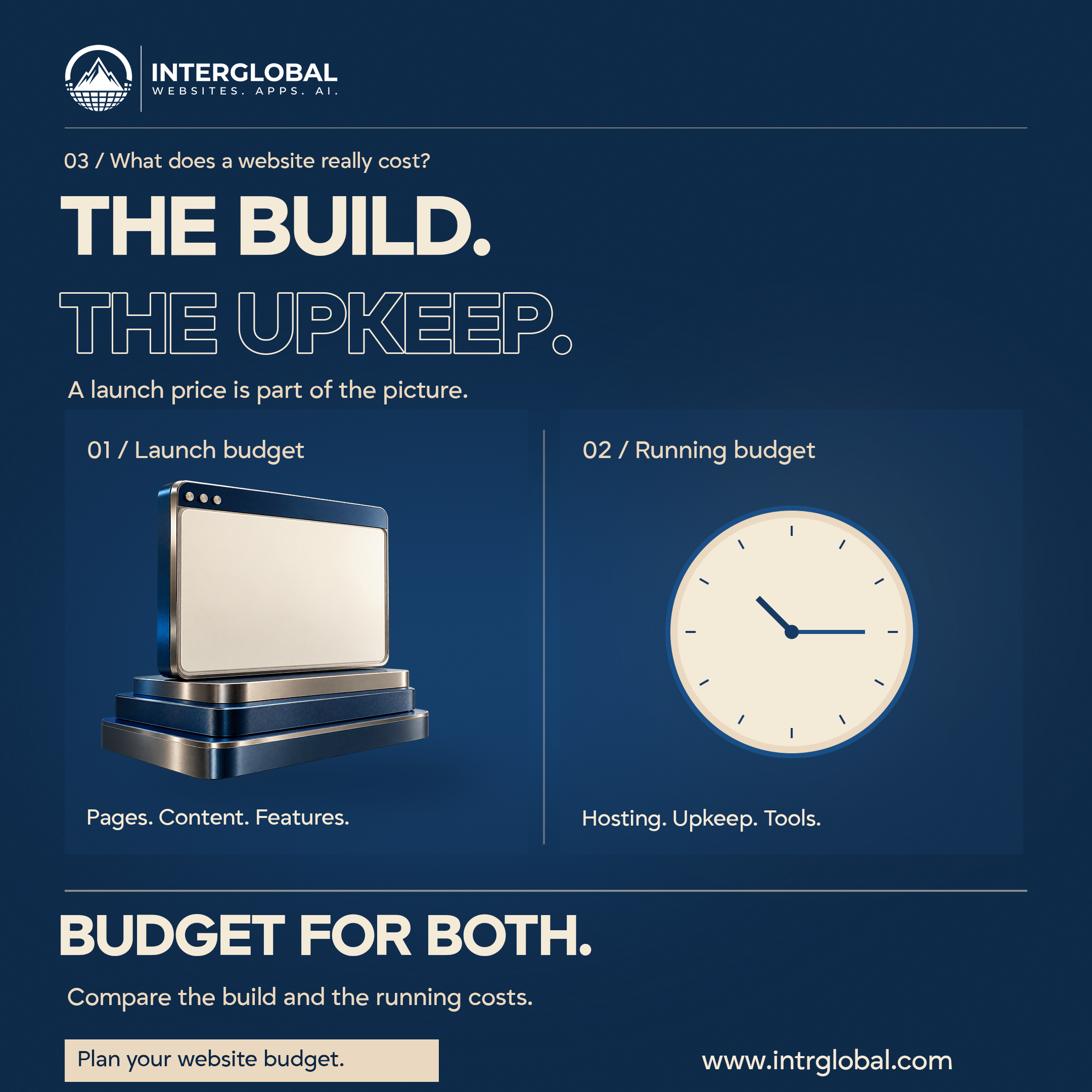

































The launch budget: what needs to exist on day one?
Start with the pages customers need and the action the website should support. Name the content those pages require, who supplies it, and who approves it. If the provider will write copy, organize photographs, or move useful material from an old site, that work belongs in the estimate.
Then list the functions. A contact form, a booking link, a product catalogue, and a checkout are different jobs. A custom connection to another system is different from linking to a tool you already use. Say what should happen when a visitor uses each function, and which accounts it depends on.
Design and implementation need a boundary too. Some projects deliver layouts for a separate developer to build. Others include the working site. Make that distinction plain before you compare totals. Include review rounds, testing, publishing, and what you receive at handover.
The launch budget should answer three things: what you will be able to use, what you must supply, and how you will agree that the work is finished.
The running budget: what continues after launch?
Ask about the domain, hosting, software subscriptions, maintenance, and any support you actually want. The mix depends on the platform. Some charges may be bundled into a plan. Others may be billed on their own. Do not assume either arrangement until you see the terms.
Write down who pays each charge, when it renews, and whether a promotional first-term price changes later. A monthly number is easier to read when the renewal period and what it includes sit beside it. Record taxes and other quoted charges when they apply. Do not guess them.
Content updates are a responsibility even when they have no separate invoice. You may need to change services, publish an article, replace a photograph, or update a team page. Will your team do that? Does the provider include a walkthrough of the editor? Is ongoing writing a separate service? Name the person who owns the task.
Support needs the same clarity. A launch support window, a maintenance plan, and unlimited future changes are different commitments. The proposal should state the support period and how a later request is estimated. A site you can edit does not mean every new feature is already paid for.
The build
Pages, content, functions, reviews, testing, publishing, and handover. This is the work required before the site is ready to use.
The upkeep
Domain, hosting, required tools, updates, and the support you choose. These charges continue after launch.
Keep required costs separate from optional marketing
Hosting the website and marketing it are related decisions. They are not the same cost. Search campaigns, social management, or paid advertising may be useful for your audience. They should be named services, with their own scope and your approval.
A feature that comes up in planning can be useful later and unnecessary for the first launch. Mark it optional. You can plan a later phase without folding it into the launch total or treating it as free.
That split makes a comparison honest. A higher total might mean more build work, a longer support agreement, recurring subscriptions, or optional promotion. You should be able to tell which one it is.
Make a first-year view from actual quoted amounts
A practical sheet has three groups: the initial work, the required recurring costs for the period you choose, and extras you approve separately. Use the amounts and billing periods the provider or the service gives you. Do not fill a blank with an industry average and call the result your quote.
If a yearly service renews inside the period, include that renewal at the quoted price. If a subscription is monthly, record the months you plan to use it. If a service is already inside a bundle, do not count it again. Keep unknown items marked as questions instead of hiding them inside a confident total.
This is a planning method. It is not a financial forecast, and it is not a promise of return. It makes the commitments visible before you choose a provider.
Check ownership and the cost of future changes
Ask who controls the domain and the hosting accounts, what access you receive, and what can move if you change providers. Portability depends on the platform and the agreement. It is better to learn those limits before you sign than during a later move.
Also ask how extra work is approved. If you add a page, change a connection, or introduce a feature after the agreed scope, who estimates it and who authorizes it? A written process gives both sides a clear route when the business changes.
Keep passwords out of the budget sheet. The sheet needs responsibilities and costs, not credentials.
Your two-budget sheet
For the build, list pages, content, functions, reviews, testing, publishing, and handover. For upkeep, list domain and hosting renewals, required software, updates, and agreed support. Beside every item, record who is responsible, whether it is included or optional, the billing period, and the quoted amount.
| Item | Side | Who is responsible | Billing period | Included or optional | Quoted amount |
|---|---|---|---|---|---|
| Pages | Build | ||||
| Content | Build | ||||
| Functions | Build | ||||
| Reviews and testing | Build | ||||
| Publishing | Build | ||||
| Handover | Build | ||||
| Domain | Upkeep | ||||
| Hosting | Upkeep | ||||
| Required software | Upkeep | ||||
| Updates | Upkeep | ||||
| Agreed support | Upkeep | ||||
| Marketing | Optional | ||||
| A later feature | Optional |
Leave every amount blank until a provider quotes it. Do not total a guess. On a phone, slide the sheet sideways. The page itself stays within the screen.
- What is still unknown?
- What is optional?
- What is counted more than once?
Resolve those three questions before you compare providers.
Plan your website budget with InterGlobal
Bring the pages you need, the customer action you want to support, the tools you already use, and any proposal you are considering. InterGlobal can help define the work so the initial build and the running responsibilities are easier to discuss.
The button opens the booking section on www.intrglobal.com. The films themselves are not links. On TikTok, the suggested platform label is Learn more, and the destination is the same booking section.
Questions before the call
Is there one price for a website?
No. The pages, content, functions, and responsibilities define the job. A launch price that skips hosting, tools, updates, or support is only part of the budget.
Does the Clutch figure mean my project costs less than $10,000?
No. Clutch’s September 2026 guide says most web-design projects reviewed on its marketplace cost less than $10,000. That is not a Dallas average and not an InterGlobal quote.
Should marketing be inside the launch price?
Only if you approve it as its own service. Hosting the site and promoting it are different costs. Optional work should stay identifiable.
What does Plan your website budget do?
It opens the booking section at https://intrglobal.com/#book. www.intrglobal.com opens the studio site.
What if I prefer less motion?
The poster stays complete, and both links still work. The budget sheet does not depend on the animation.