Is 40 too old to become a web developer?
Quick answer: Forty does not decide whether you can learn web development. Start with the foundations, finish one project you understand, and be able to explain it. Learning and getting hired are separate steps.
A more useful starting point is the time you can give to practice, the kind of work you want to do, and the evidence you can build. A first working page is useful practice. It does not guarantee a job, a salary, or a date when a career change will happen.
This article is about learning and showing what you understand. It is not a hiring forecast, and InterGlobal is not offering a training course or career placement. If you run a business, the button below is a conversation about a website project.
What's in this article?
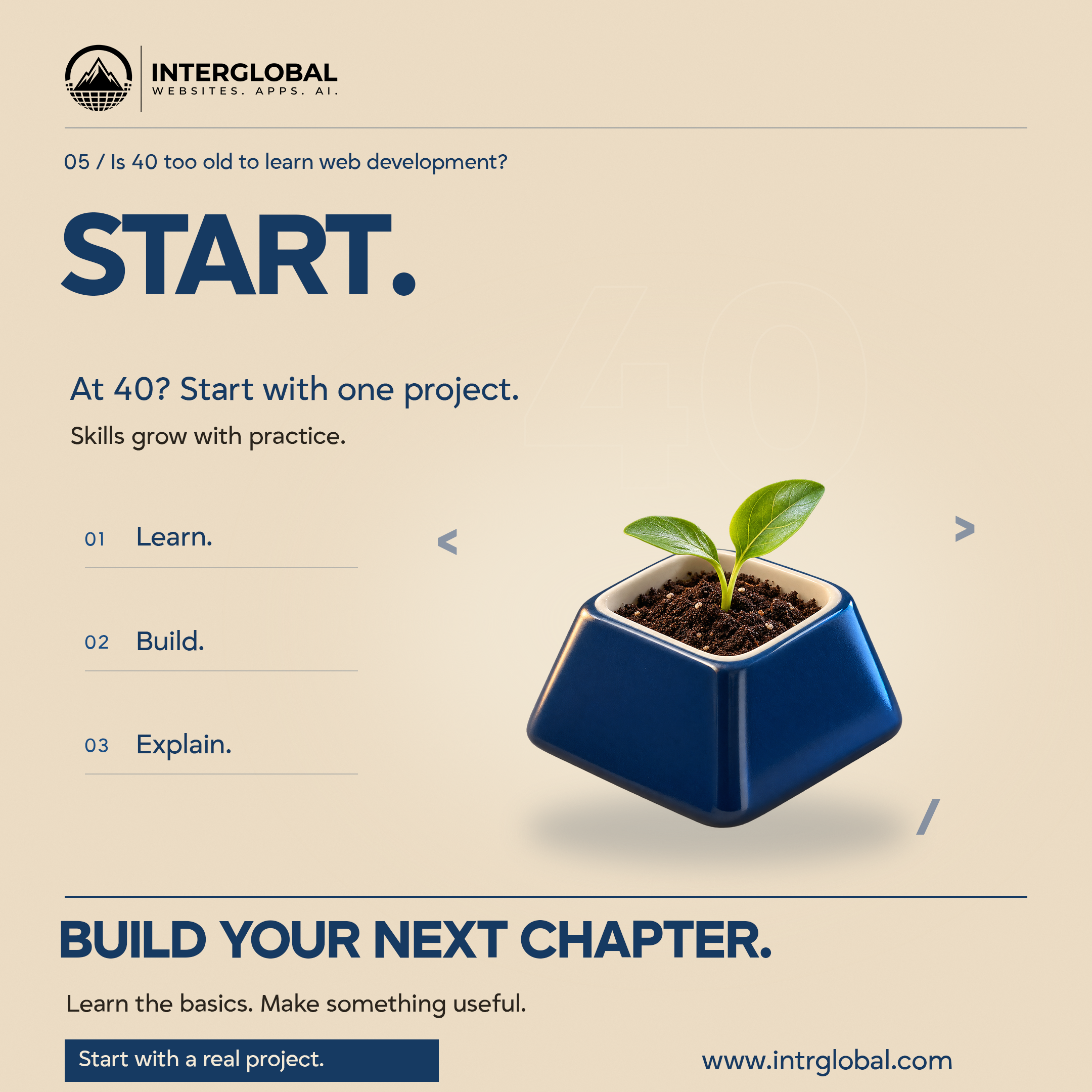
The poster, in motion
The square below plays once when it comes into view. Replay runs it again. If you prefer less motion, the finished poster stays in place and both links still work.




























Choose the reason you want to learn
You might want to understand your own business website, contribute to a team, or explore a new profession. Those goals share some foundations, but they lead to different first projects.
For a Dallas business owner, a useful learning project might be a clear service page that works on a phone. For someone exploring frontend development, it might be a small multi-page site with consistent navigation and a documented review. Choose a task you can finish and describe, rather than a large application that depends on several unfamiliar systems at once.
Write down the audience, the information they need, and one action the page should support. That gives the work a purpose. It also helps you decide what to leave for a later version.
Learn the foundations in a structured order
Mozilla's MDN Curriculum offers a free, self-paced beginner framework. Its core topics include semantic HTML, CSS, JavaScript, accessibility, design, and version control. It is a useful reference for planning practice and finding gaps. Following a curriculum does not prove readiness for every job, and it does not set a deadline. MDN Curriculum.
Start by understanding how content is structured. Add styles that make the content readable and organize the layout for different screen sizes. Learn the behavior your project actually needs, then check how that behavior works for the person using the site. Keep access and clear navigation in the practice, rather than leaving them until the page looks finished.
Tools and frameworks can come later, when the project requires them. A smaller piece of work you understand gives you something to build on when you meet a more complex task.
Make one useful project
A first project should have a clear finish. For example, create an informational site for an imaginary local service business. Use clearly labelled sample content, a homepage, a service explanation, and a contact route that does not pretend to belong to a real company.
Write the page yourself, inspect it on a phone, and revise it when the text or layout is confusing. Keep a record of what you changed and why. If you use reference material or assistance, be able to explain how the important parts work. Copying a complete solution without understanding it makes the next problem harder to solve.
Avoid collecting customer information or handling payments as a beginner exercise. A simple informational project lets you practice structure, layout, and interaction before taking on the responsibilities of a real transactional system.
When the project is for an actual business, agree on its scope and review before making it public. Accuracy, account access, and the functioning customer journey matter to the business using it.
Practice explaining your choices
After a working version, answer a few questions in plain language. Why did you choose that page structure? How does the layout change on a narrow screen? What happens when a link is activated? What did you test, and what still needs work?
Those explanations show the parts you understand and the parts you should revisit. You can turn them into a short project note with the brief, screenshots, decisions, checks, and known limits. Keep claims honest. Describe the work you did, rather than claiming a business result you did not measure.
Ask another person to try the project. Give them a task and observe where they get confused. Use the feedback to improve the experience. A finished first version becomes more useful when you can show how you revised it.
Fit practice into the time you actually have
Choose a routine that fits your responsibilities. A consistent block of focused practice is more useful than a plan built around hours you cannot reliably protect. Set a small next task before you begin: structure a page, repair a layout, understand an interaction, or check the phone view.
At the end of a session, record what you completed and the question you need to resolve next. That makes it easier to return after work or family commitments. You can change the pace when the plan stops fitting your life. Learning does not need an invented deadline to count as progress.
Track completed tasks and improved understanding rather than comparing your start date with someone else's career. Prior experience with customers, writing, operations, or project coordination may give you useful context. You still need to demonstrate the technical skills relevant to the work you want to do.
Check the actual requirements of a role
If employment is the goal, read real role descriptions and look for repeated requirements. The Bureau of Labor Statistics notes that education requirements for web developers and digital designers vary, ranging from a high school diploma to a bachelor's degree depending on the setting. That national description does not mean every employer accepts the same background, and it says nothing about age. BLS: Web Developers and Digital Designers.
Use the requirements to identify gaps in your practice, portfolio, and experience. Ask what a role expects you to build, maintain, or test. Keep the move from learning to paid work grounded in evidence, feedback, and the circumstances of the opportunity.
A course completion, a birthday, or a single polished page cannot settle that assessment on its own. A clear record of projects and the ability to explain your work gives you a more concrete basis for the discussion. None of this is a promise of employment.
A first-project sheet
For your next project, record the audience and task, the pages you will build, the foundations you need to practice, and a definition of finished. Add checks for readable content, phone layout, navigation, and the action you want the visitor to take.
Then write three short notes: what you learned, what you built, and what you can explain. Mark anything unresolved so it becomes the next practice task.
| Note | Your answer |
|---|---|
| Audience and task | |
| Pages to build | |
| Foundations to practice | |
| Finished means | |
| Phone and navigation check | |
| What I learned | |
| What I built | |
| What I can explain | |
| Still unresolved |
Leave a cell empty until you know the answer. The sheet does not score you, and it does not estimate a time to a job.
Start with a real business project
If you are a business owner planning a website, bring the customer task and the work you want the site to support. InterGlobal can help define a practical project brief and discuss what needs to be designed, built, and checked. That conversation is about the website, not enrolment in a course. Visit www.intrglobal.com.
Key takeaways
- Age is not a measure of the skills you can build. Start with one project you can finish.
- MDN's beginner curriculum is a free practice framework. Completing it is not proof of job readiness.
- BLS says education requirements vary by setting, from a high school diploma to a bachelor's degree. That is not an age rule and not a hiring promise.
- Learn, build, and explain. Keep a note of what is still unresolved.
Questions people ask
Is 40 too old to become a web developer?
Forty does not answer that. The useful questions are how you will practice, what project you can finish, and whether you can explain how it works. A first project is not a job offer.
Does the MDN curriculum mean I am ready to be hired?
No. MDN offers a free, self-paced beginner framework covering HTML, CSS, JavaScript, accessibility, and version control. It helps you plan practice. It does not prove readiness for every role.
Does the BLS say I need a specific degree?
The Bureau of Labor Statistics says education requirements for web developers and digital designers vary by setting, from a high school diploma to a bachelor's degree. Employers differ. The description is not a personal promise and it does not mention age.
What does Start with a real project do?
It opens the booking section at https://intrglobal.com/#book so a business can talk about a website. It is not course enrolment or career placement. www.intrglobal.com opens the studio site.