Is it worth hiring a web designer?
Quick answer: Hiring a web designer can be worth it when you can name the work your business needs help with. Review direction, detail, and delivery before you agree. A finished look is not the same as a result you can check.
A small correction to accurate content may need a focused improvement. A changed offer, a confusing page structure, or a customer journey that stalls may need more design work. Choose the level of help that fits the task. Do not assume every business needs a complete redesign.
This article is about the decision to hire. It is not a price list, a hiring-process checklist, or a promise of leads. The button below opens a conversation about a business website brief.
What's in this article?
The poster, in motion
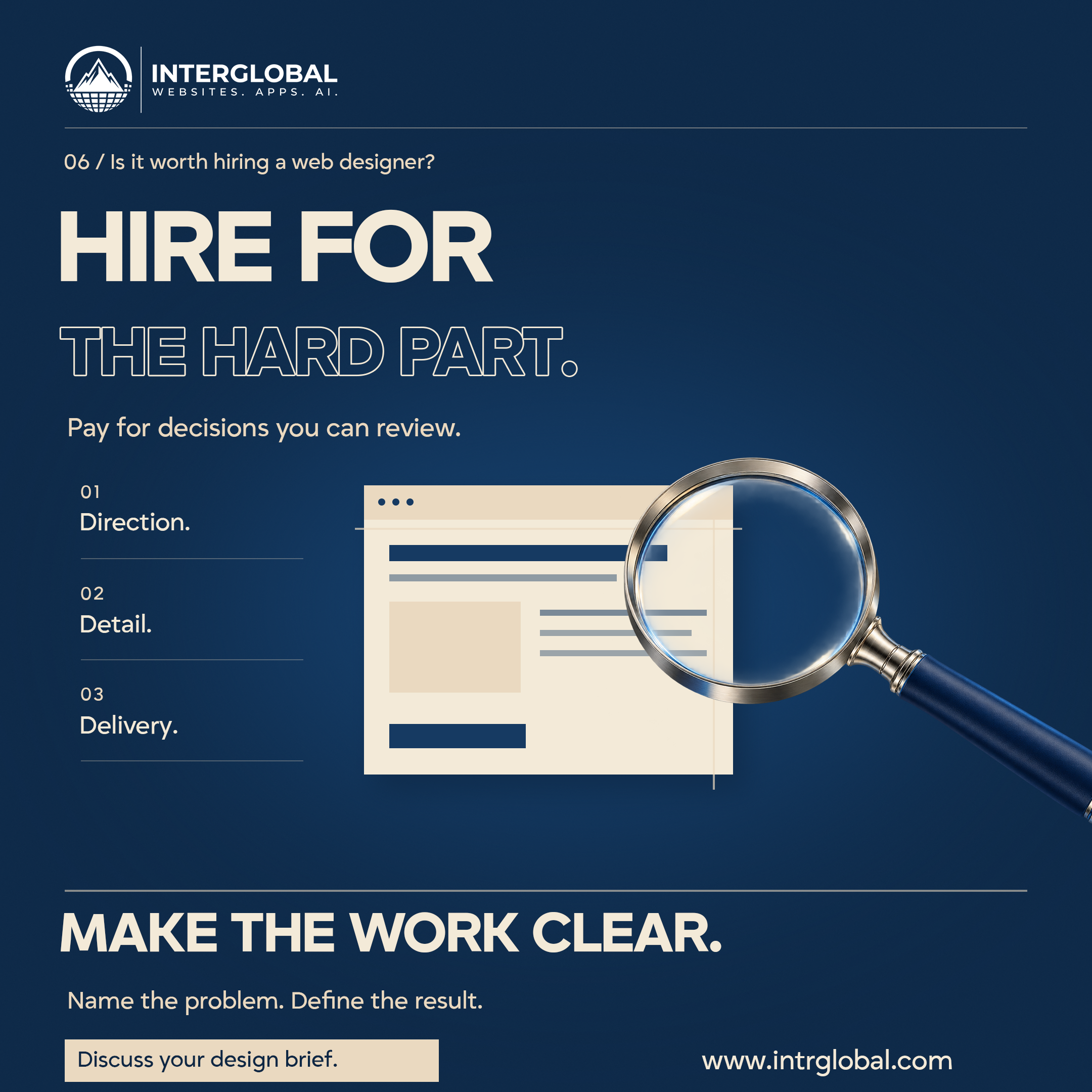
The square below plays once when it comes into view. Replay runs it again. If you prefer less motion, the finished poster stays in place and both links still work. The layout board is an illustration, not a live website.







































Name the problem before you choose a provider
Explain what is happening now. Visitors may be unable to tell which service fits them. The phone layout may hide useful information. The main contact route may be difficult to complete. Describe the task and the observable problem in plain language.
For a hypothetical Dallas service business, each service might be listed without saying who it is for. A useful brief could ask for a clearer service structure and an inquiry route that collects what the first conversation needs. That example is a planning scenario. It is not a client result and it does not promise more inquiries.
If you cannot yet describe the problem, a discovery or review phase may be the first piece of work to discuss. Define what you expect to receive from that phase and how it will guide the next decision.
Direction: organize the message
A designer can help decide what information belongs first, how pages relate, and what a visitor should be able to do next. That direction should follow the business's actual offer and the customer's task.
Ask the provider to explain important choices. Why this page order? Why this navigation? What question does this section answer? Which action does this screen support? You should be able to connect the proposed direction to the brief.
Your team still needs to supply and approve accurate business information. Agree on whether the designer will organize existing content, write new material, or work with another contributor. A strong direction depends on both the design work and the information behind it.
Detail: review the experience
The Bureau of Labor Statistics describes digital design duties that include developing and testing layouts, functions, and navigation for usability. That broader description is a reminder to ask about the experience being reviewed, rather than judging the work only by one attractive screenshot. It is not a salary figure, a return-on-investment claim, or proof that a particular project will be usable. BLS: Web Developers and Digital Designers
Review the relevant tasks on a phone. Can visitors read the content, find the right page, and understand what happens when they use the main action? What happens with longer text, a form error, or a narrow screen? Does the design stay coherent across the pages you need?
Accessibility belongs in that conversation too. W3C's introduction explains that websites should be designed and developed so people with disabilities can perceive, understand, navigate, and interact with them. It also notes that a tool alone cannot establish accessibility. Knowledgeable evaluation is needed. Those principles support asking about review methods. They are not a compliance certificate for a project. W3C WAI: Introduction to Web Accessibility
Ask for concrete demonstrations: keyboard navigation, readable content, clear controls, and a working customer task. Agree on the checks that are included and any additional expertise the project requires.
Delivery: decide what you will receive
The word design can cover different deliverables. A project might produce layouts, a reusable design system, a prototype, or a working website. Name the result in the agreement so both sides understand the finish.
If someone else will implement the design, discuss the handoff. If the provider will build the site, discuss the forms, testing, and publishing responsibilities. Include review rounds and how later changes will be estimated and approved.
You should know what files or account access you receive and who updates the site afterwards. The answer depends on the platform and the scope. Resolve those details while the work is being defined.
Compare the work with what your team can handle
A template or an existing site can be a useful starting point when your message is clear and the functions fit. Your team may be comfortable updating text or adding a straightforward page. A focused design review can also be useful without replacing the entire site.
More help becomes easier to justify when the project has unresolved decisions, several customer journeys, an inconsistent interface, or functions that need coordination across people and systems. The size of the assignment should follow those requirements.
Write down which parts your team can own and which parts need outside support. Consider the time you can actually protect for the work and the skills needed to check the result. This is a planning assessment, not an automatic return-on-investment calculation.
Ask for a relevant walkthrough
Ask the designer to walk through a project or a sample approach relevant to your task. Look for explanations of the brief, decisions, revisions, and checks. Confirm what the provider personally handled and what another team member delivered.
A portfolio can show visual style. The discussion should also help you understand how the provider works with feedback and turns an unclear brief into a reviewable result. Do not treat an unrelated site's appearance as proof that your required functions are covered.
Agree on how you will review the work before implementation or publication. Clear checkpoints make it easier to identify an unresolved decision while it can still be changed.
Use a direction, detail, and delivery sheet
For direction, record the customer task, the message that needs organizing, and the decision you want to review. For detail, record the important page states, the phone experience, and the checks you expect. For delivery, record the files or working site, the handover, account responsibilities, and the support window.
Beside each item, name the responsible person and the evidence they will show. Mark gaps as questions. The sheet gives the hiring discussion a concrete purpose and helps a provider estimate a defined piece of work. Leave the cells empty until you fill them for your own project.
| Area | Responsible person | Evidence | Unresolved |
|---|---|---|---|
| Direction: customer task and the decision to review | |||
| Detail: phone layout, page states, and checks | |||
| Delivery: files or site, handover, and support |
Fill the sheet with your own names and examples. It does not calculate a return, predict leads, or certify accessibility.
Discuss your design brief with InterGlobal
Bring the current website, the customer task, and the parts of the project you find difficult to define. InterGlobal can help discuss the direction, details, and deliverable your business needs. This is a scoping conversation for a business website, not a training course or a placement service.
Bring the hard part of the project. Name what the customer should understand and what you expect to receive.
Discuss your design briefThe studio site is www.intrglobal.com.
Key takeaways
- Hire when you can name the work, the review, and the deliverable.
- Direction covers the message and the next action. Detail covers the experience you will actually check.
- Delivery names layouts, a prototype, or a working site, plus handover and support.
- A national role description and an accessibility introduction are planning references. They are not a guarantee or a certificate.
Questions people ask
Is it worth hiring a web designer?
It can be, when the problem, the review, and the deliverable are defined. A small content fix and a confusing customer journey are different kinds of work.
What should the review include?
Ask how the provider will test the important parts, including the phone layout and the customer action, and how your feedback will be handled. Agree on the checks that are included.
Does a role description prove the project will succeed?
No. The Bureau of Labor Statistics describes duties such as testing layouts and navigation for usability. That is a national job description, not a result for your site. W3C's accessibility introduction explains the need for knowledgeable evaluation. It is not a compliance certificate.
What does Discuss your design brief do?
It opens the booking section at https://intrglobal.com/#book so a business can talk about a website brief. It is not course enrolment or career placement. www.intrglobal.com opens the studio site.