Is $1,500 a good price for a website?
Quick answer: $1,500 is only a good fit when the written proposal covers the work you need, the responsibilities you keep, and the costs that continue. The number by itself is not an answer.
This article uses $1,500 as a hypothetical budget in the question. It is not an InterGlobal rate, a Dallas market average, or a promise that a provider will include a particular feature at that price. It also does not reuse hourly ranges from a rate sheet. The useful comparison is the assignment behind this specific amount.
What's in this article?
The poster, in motion
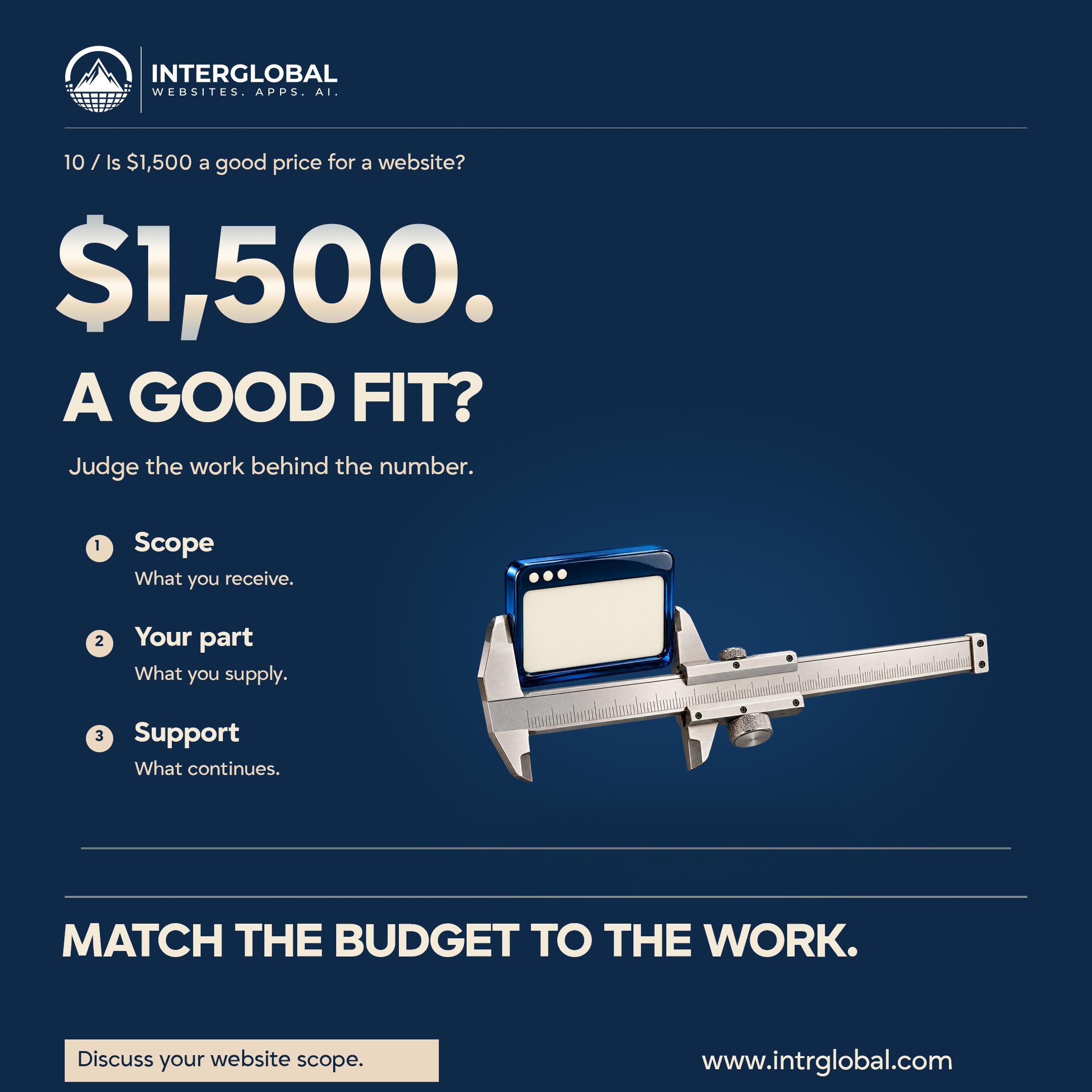
The square below plays once when it comes into view and pauses when it leaves the screen. Replay runs it again. If you prefer less motion, the finished poster stays in place and both links still work. The caliper and blank browser are one still picture. The amount on the poster is the question's hypothetical budget, not a price list.




























Start with the first version
For a Dallas business, describe what a visitor should understand and do. A small service business may need a clear explanation of its offer and a functioning inquiry route. Another business may need inventory, accounts, or a connection to a system it already uses. Name those tasks before you decide whether a proposal covers the work.
Write the pages and functions that are necessary for the first version. Keep useful later ideas on a separate list. That lets you discuss a smaller assignment without pretending the later work is already included.
Ask the provider to explain the result they propose within the amount you are considering. If a requirement does not fit, discuss which part needs another phase or a revised assignment. Cutting the list helps only when the remaining version can still do its job.
Check what you receive
Read the deliverable in practical terms. Will you receive approved layouts, a working site, a published site, or a defined set of improvements to an existing one? Those results leave different work still to finish.
Look for the actual pages, functions, content work, review points, and launch checks. Ask what happens when you request another page or change a function. Resolve what is included before you use the amount as the basis for a decision.
Agree how completion will be reviewed. If the main task is an inquiry, you should be able to try that route with the agreed content and confirm the result. An attractive page does not by itself show that every expected function has been delivered.
Check what you supply
Some assignments depend on writing, photographs, or brand files that the business supplies. Identify the material and who will prepare it. If those assets are not ready, discuss the work needed rather than assuming it disappears inside the proposed fee.
Decide who approves business facts and the offer. Keep fictional reviews, clients, and results out of the material. Give the provider a contact who can resolve questions and coordinate feedback.
Your time belongs in the plan too. Agree when you will review the work and what information you need to provide. A missing dependency can stop a defined assignment, even after the amount has been discussed.
Check what continues
Identify hosting, the domain, software, and other recurring services separately. Ask whether any are bundled and how they are paid. Do not count the same item twice, and do not assume an initial website fee includes every future service.
Clarify ongoing changes and support. Who updates content after delivery? What happens when the business changes a service or needs help with a tool? Record what is included and what requires another assignment.
Also discuss the files, instructions, and access you will receive. The way you operate the site after launch should be clear enough that a future update does not depend on an unrecorded assumption.
Compare two hypothetical situations
Imagine that you already have approved copy, suitable photographs, and a defined inquiry route. You ask for a limited set of pages and a reviewed working version. That gives a provider a bounded assignment to evaluate. It does not establish that every provider will accept $1,500 for it.
Now imagine you need new writing, several customer journeys, account functions, and connections to other systems. Treating the same amount as proof that all of this is covered would leave important questions unanswered. Ask for a written proposal that explains the work and the dependencies.
The distinction is the assignment behind the number. These are editorial examples, not quotes, case studies, or market benchmarks. Use them to see which situation is closer to your project, then discuss the actual work with the provider.
Use a budget-fit sheet
Use the empty sheet for the required result, the included work, your responsibility, and the continuing cost or open question. Fill it from the written proposal. Mark a missing detail as a question. Do not add a guessed amount.
| Required result | |
|---|---|
| Included work | |
| Your responsibility | |
| Continuing cost or open question |
Choose a review check for each essential result. If the result is a functioning inquiry route, record how you will try it. If the result is design files for a separate builder, record the handover and who implements them. The sheet helps you discuss an assignment. It does not calculate a fair market price or predict a return.
Decide the first version deliberately
If the proposal covers a useful first version, define that version clearly. Keep later features separate, including their review and any later cost discussion. A later phase should be a visible choice, not an unfinished item hidden behind the first amount.
If the essential task is still unclear or excluded, resolve it before you accept the work. You may need a different scope, more preparation, or another proposed amount. Ask for that explanation rather than deciding from the number alone.
Discuss your website scope
Bring the customer task, the pages you need, and the content you already have. InterGlobal can discuss the assignment and the responsibilities involved in building your website. This conversation does not publish a $1,500 offer or a market average.
Match the budget to the work. Bring the first version you need and the responsibilities you already know.
Discuss your website scopeThe studio site is www.intrglobal.com.
Key takeaways
- $1,500 in this article is a hypothetical budget, not an InterGlobal price or a Dallas average.
- Judge the pages, functions, and review points you will actually receive.
- Name the content and decisions you supply, and the services that continue after launch.
- Keep a later phase visible instead of assuming it is included in the first amount.
Questions people ask
Is $1,500 a good price for a website?
Only when a written proposal shows the work included, the responsibilities you retain, and the costs that continue. The amount alone does not answer the question, and it is not a published InterGlobal rate.
What should the proposal list?
The pages, functions, content work, review points, and what you receive at the end. Ask what happens if you add a page or change a function.
Does the first amount include hosting and later changes?
Do not assume that. Ask which services continue, how they are paid, and which updates need another assignment.
What does Discuss your website scope do?
It opens the booking section at https://intrglobal.com/#book so a business can talk about the assignment. www.intrglobal.com opens the studio site.