How can I hire someone to design my website?
Quick answer: Hire website design help by writing the customer task first, then reviewing relevant work, comparing a written proposal, and agreeing on the points you will check.
A brief gives both sides something concrete to discuss. It names the person the website needs to help, the pages and functions involved, and who is responsible for the content. A portfolio, a title, or a rate does not replace that assignment.
This article is about the hiring process. It is not a decision about whether to hire, and it is not a rate card. It does not publish an InterGlobal price or promise a business result.
What's in this article?
The poster, in motion
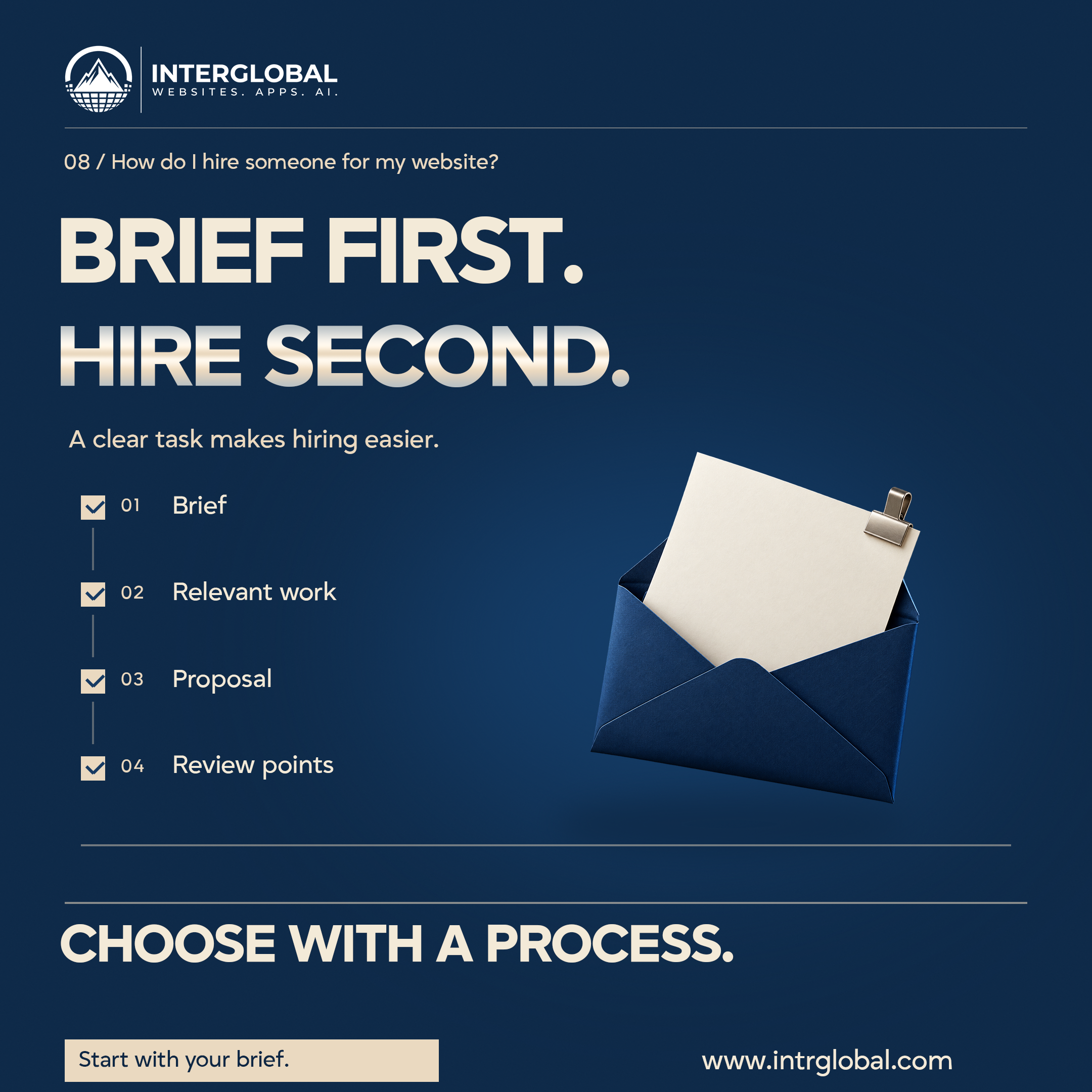
The square below plays once when it comes into view and pauses when it leaves the screen. Replay runs it again. If you prefer less motion, the finished poster stays in place and both links still work. The envelope and blank page are a still picture of a brief, not a signed contract.





























Start with the customer and the task
For a Dallas business, begin with the person the website needs to help. That might be a homeowner comparing a service, a buyer researching a product, or a client trying to book an appointment. Describe what that person needs to understand and what they should be able to do. That description is more useful than asking for a site that simply looks modern.
Then identify what you already have. List existing pages, useful photographs, written content, brand files, and any functions you need to keep. Mark the material that still needs to be created. You do not need a finished specification before the first conversation, but you should make the open questions visible.
Write a one-page assignment
Describe your audience, the main customer task, the pages you expect, and the functions you need. A service website might need a clear explanation of the offer and a working inquiry route. A different business might need appointments, a catalogue, or an account area. Those are different assignments.
Name the responsibilities too. Who writes the copy? Who selects and clears the images? Who supplies product information? Who configures the booking tool? If the answer is unknown, put it on the list for discussion rather than assuming it belongs to the designer.
Include the desired timing and any real dependencies, such as waiting for photography or product details. State the budget you are prepared to discuss without treating it as a promise that every requested feature fits. Ask the provider to explain what can be delivered within the assignment and what needs another phase.
Review relevant work and the person's role
Look for examples that show a comparable customer task. A beautiful portfolio can start the conversation, but your project also needs a clear structure and functioning pages. Open examples on a phone and follow the main route. Can you find the offer, understand the next step, and use the relevant control?
Ask the candidate what they personally contributed. Did they organize the content, create the design, implement the site, or coordinate a team? A shared project can still be relevant, but you need to know which responsibilities this person proposes to cover for you.
Ask for an explanation of a decision in the work. Why did they put the inquiry route there? How did the layout handle longer content? What changed after review? Their explanation can help you understand how they approach problems. It does not guarantee the same result for your business.
Compare written proposals against the same brief
Ask how the work moves from the brief to a working website. Useful review points might include a proposed page structure, a visual direction, and a functioning version. The exact process should fit the project. What matters is that you can understand what you will review and when a decision is needed.
Ask each shortlisted provider to respond to the assignment you described. Check the deliverable, responsibilities, review rounds, dependencies, launch work, and handover. A proposal for design files serves a different purpose from one for a published, functioning website.
Resolve the gaps before choosing. If copy is excluded, who will supply it? If an integration needs an account, who sets that up? If another person builds the design, who coordinates the handoff? Keep the proposed fee tied to the actual assignment. This article explains the process. It does not establish a market rate.
Bring accessibility into this conversation early. W3C's planning guidance recommends integrating accessibility throughout production, assigning responsibilities, and evaluating early and regularly. Ask who will carry out those checks and how findings will be addressed. That source is planning guidance for responsibilities and early review. It is not a legal guarantee, a compliance certificate, or a general hiring standard. W3C: Planning and Managing Web Accessibility
Agree on review points you can use
At the structure review, check whether the planned pages answer the customer's questions and support the intended task. At the design review, check the hierarchy, the content, and the phone layout. At the working-site review, use the real links, forms, and any agreed functions.
Ask to try the main route with a keyboard as well as on a phone. Review real content, including longer headings or descriptions where they occur. Record a specific issue and the result you need. For example, the appointment link is hard to find on a phone and should be clear beside the relevant service.
Agree on who confirms that issues have been resolved. A review point should help you make a decision about the actual website rather than approve a screenshot whose functions you have not tried. Agree on how feedback will be collected, and how a request that changes the assignment will be made clear before more work proceeds.
Clarify handover and continuing responsibilities
Before completion, discuss the files and documentation you will receive, who controls the domain and hosting accounts, and who can update the content. Ask the provider to describe the agreed ownership and access arrangements in writing. Resolve questions about rights through the actual agreement rather than assuming every tool or asset transfers in the same way.
Identify any continuing support separately. What happens if you need a content change, a tool update, or help with a problem after launch? Clarify what is included and what needs a new assignment. Keep a record of the accounts, contacts, and instructions needed to operate the site.
Fill in a hiring brief
Use an empty worksheet for the audience, the main customer task, the pages, the required functions, the content owner, the review checks, and the handover needs. Add notes from the conversation and leave unanswered questions blank. Do not treat an example as your own client, price, or result.
| Audience | |
|---|---|
| Customer task | |
| Pages | |
| Functions | |
| Content owner | |
| Review checks | |
| Handover needs |
The worksheet is a starting point for a discussion. A provider may help you refine it, remove an unnecessary feature, or identify a missing dependency. That is useful progress before the production work begins.
Start with your brief
Bring the customer task, the pages you need, and the material you already have. InterGlobal can discuss the assignment and the steps involved in designing and building your website. This is a scoping conversation, not a published rate card.
Write the task before you choose. Bring the audience, the pages, and the material you already have.
Start with your briefThe studio site is www.intrglobal.com.
Key takeaways
- Start with the customer and the task the website needs to help them complete.
- Review relevant work, and ask what the person personally contributed.
- Compare a written proposal with the same brief, including review points and handover.
- Try the working route on a phone and with a keyboard before you approve it.
Questions people ask
How can I hire someone to design my website?
Write the customer task, the pages, and the content responsibilities. Then review relevant work, compare a written proposal, and agree on the points you will check.
What belongs in the brief?
The audience, the main customer task, the pages, the functions, who owns the content, the review checks, and the handover needs. Leave unknown items as questions.
Does a portfolio prove the person can do my project?
A relevant example can start the conversation. Ask what that person personally contributed, and ask them to explain a decision. Their explanation is not a promise of the same result for your business.
What does Start with your brief do?
It opens the booking section at https://intrglobal.com/#book so a business can talk about a website assignment. www.intrglobal.com opens the studio site.