#brandingdallas2026: A Branding Guide Is the Most Important Part of a Marketing Project
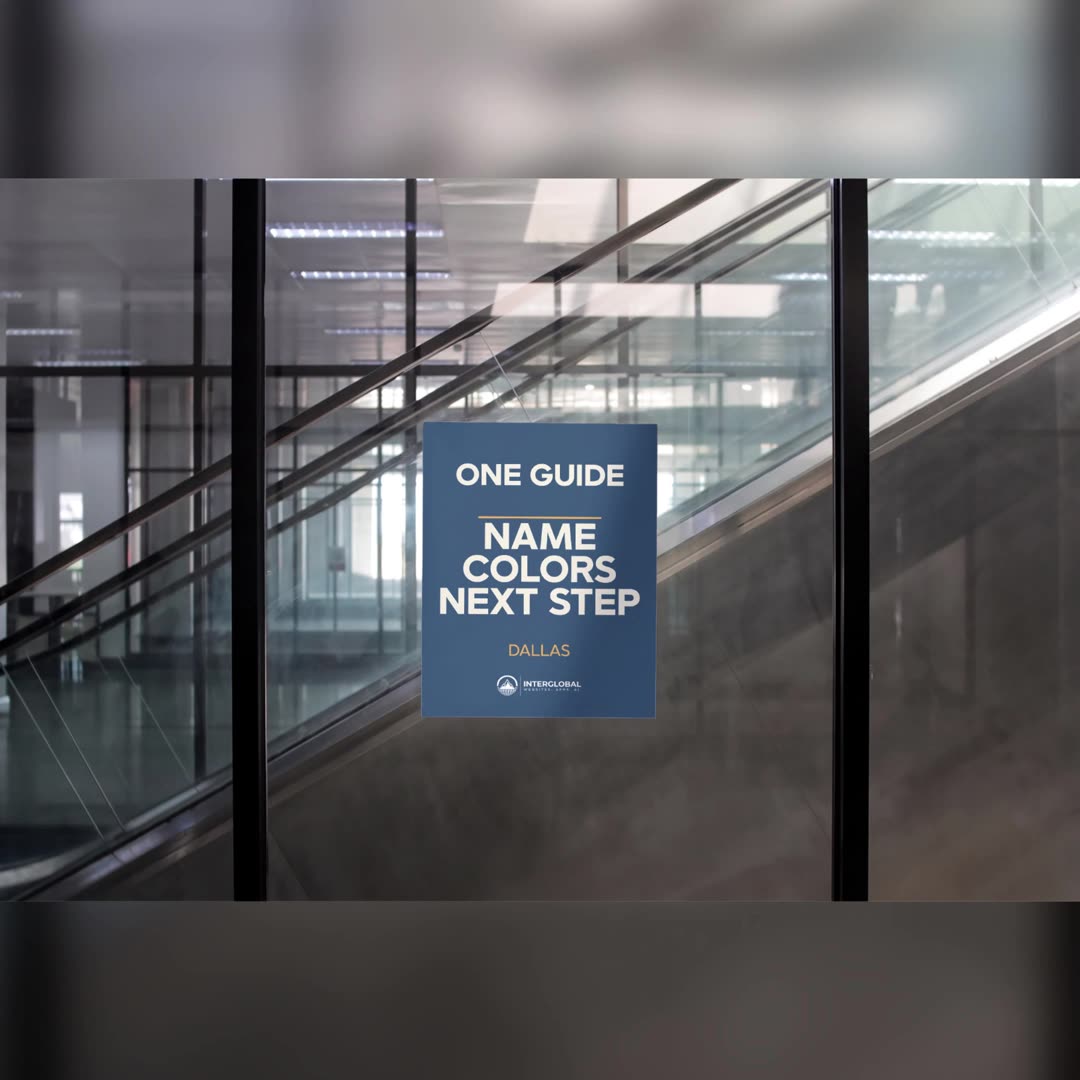
Quick answer: #brandingdallas2026 is a branding guide for a Dallas marketing project. Write the name, the colors, the words, and the next step before anyone designs a poster, a screen, a door hanger, a badge, or a board. Later pieces copy that sheet. This is InterGlobal’s working rule, not a ranking and not a survey.
- One spelling of the name, said the same way out loud.
- Color values a printer and a screen can both match.
- One next step: call, book, visit, or order.
- The same string on the article title, the heading, and the social caption, so a search for that exact phrase can find one page.
What's in this article?
Transcript
A branding guide is the one sheet that keeps a marketing project from wandering off.
The poster, the tablet, the door hanger, the badge, and the board should all look like the same company.
A guide is not a pile of logos. It is the name, the colors, the words, and the next step, written down before anyone designs.
On a poster, the guide decides how big the name is, and where the logo sits.
On a tablet, that same guide has to work on a screen, not only on paper.
A door hanger gets one glance at the door. The guide decides what that glance is allowed to say.
An ID card is tiny. If the mark still reads there, it can read everywhere else.
A tall board on a Dallas street has to follow the same rules, or the drive-by version becomes a second brand.
InterGlobal writes the guide, then builds the site, the local search, and the ads from that same sheet.
Check four things: the name, the colors, the words, and the next step.
Write those four down, and the rest of the project can agree.
Book a call. inter global dot com. Start with the guide.
Why the guide comes first
A marketing project has a lot of pieces. The site, the local search, the ads, the print, the badge someone wears to a job. Those pieces only agree if someone wrote the rules down first. That sheet is the branding guide. InterGlobal treats it as the first piece of the project, ahead of the ad account and ahead of the page design, because the later work is supposed to copy it.
This is a working rule from the studio, not a claim that a study ranked branding guides above every other task. Ads still matter. A website still matters. Local search still matters. They fail in a specific way when each one invents its own name, its own blue, and its own phone number.
Dallas makes the split easy to see. A customer might meet you on a lobby poster in the morning, on a phone at lunch, and on a tall board from the highway at night. If those three versions disagree, the person does not file them as one company. They file them as three guesses.
A folder of logos is not a guide
A zip of logo files, a mood board, and a favorite blue are useful raw material. They are not a guide. A guide is short enough that a designer, a printer, and the person who updates the site can follow it without a meeting. If a line is blank, that part of the project is guessing.
Why this matters before the first design
The first design sets a habit. If the poster uses one name and the site uses a longer one, the ad will copy whichever file the media buyer opened last. Writing the sheet first is cheaper than reconciling five finished files after they have already been printed, posted, and boosted.
Write it in sentences. A guide that only a designer can read will be ignored by the person who answers the phone. The name, the offer, and the next step should make sense when they are read out loud.
What belongs on the sheet
Keep six lines. Add a seventh only when a real job needs it, such as a second language or a product line that must look different on purpose.
The name
One spelling. One way to say it out loud. If the legal name and the name on the door differ, write both and say which one customers should see. Do not let the poster, the Google listing, and the website each pick a favorite.
The colors
Write the values. “Blue” is not a color a printer can match, and it is not a color a screen will repeat. Record the values you actually use, and name the background the logo is allowed to sit on. A white logo on a light photo disappears. A dark logo on navy does the same.
The words
The offer in one sentence, and the words you will not use. The sentence should say what the business does and who it is for. The banned list is how you stop a rushed caption from inventing a promise the business cannot keep. No invented rankings, no invented review counts, no “we guarantee the leads.”
The next step
Call, book, visit, or order. One step, written the same way everywhere, with the same phone number or the same page. A poster that says “learn more,” a site that says “get a quote,” and an ad that says “call now” are three projects. Pick one for this campaign and put it on the sheet.
The logo
The real file, on a background where it can be seen. Do not redraw it because a deadline got loud. Write where it sits: left, centered, or in a corner, and the smallest size that must still read. The film uses the official InterGlobal logo on a dark field for that reason. The mark in the mockups is ours. The rooms, the hands, and the street are not clients.
The small size
If the mark still reads on a badge, it can read on a board. The badge is the hard test because there is almost no room. If the name only works when it is huge, it will fail on a card, a favicon, and a map pin.
Five places, one company
A customer in Dallas–Fort Worth does not meet you in one place. They might see a poster in a lobby, a page on a tablet, a hanger on a door, a badge on a lanyard, and a tall board from the street. If five people designed those five things with no shared sheet, you get five brands wearing one name, or five names wearing one budget.
The poster
The guide decides how big the name is and where the logo sits. The paper has edges. Type that looks fine on a laptop can fall off the printable area. Check the finished poster at the size it will be seen, not at 400 percent in the design file.
The tablet
The same guide has to work on a screen, not only on paper. A screen moves. The name, the offer, and the next step should still be readable when the page is scrolled, and the logo should still be the real file. Shrinking the poster until it fits the glass is not a screen design.
The door hanger
A hanger gets one glance at the door. The guide decides what that glance is allowed to say. Usually that is the name, one line, and the next step. A hanger that retells the whole company story gets thrown away with the menus.
The badge
An ID card is tiny. If the mark still reads there, it can read everywhere else. This is the test you do before you order a tall board, not after.
The board
A tall board on a Dallas street has to follow the same rules, or the drive-by version becomes a second brand. People see it at speed. Short words, the real colors, and the same next step. A clever line that only works if you stop the car is a poster, not a board.
The pictures in the film are mockups. The glass lobby, the chair, the hangers, the badge, and the street are not clients, and they are not results. They are five surfaces used to show one set of rules.
Check a piece before it goes out
Hold the new piece next to the guide and ask four questions.
- Is the name spelled the same way?
- Are the colors the ones on the sheet, not a close cousin?
- Are the words the ones you agreed to?
- Is the next step the same sentence, with the same phone number or the same page?
If any answer is no, fix the piece. “Let this one be different” is how the brand splits. The printer being in a hurry is not a reason to invent a new blue.
Start with the sheet, then the site.
InterGlobal writes the guide with you, then builds the website, the local search, and the ads from that same page. The visit is free, in Dallas–Fort Worth or by video.
Book the visitA one-page starter
Copy this table into a document your printer and your site editor can both open. Fill it before the next design.
| Line | What to write | A fail you can spot |
|---|---|---|
| Name, exactly | The spelling customers should see, and how to say it. | The door, the site, and the ad each use a different version. |
| One-sentence offer | What you do, and for whom, in one sentence. | The sentence could describe any business on the block. |
| Colors, with values | The values, and the backgrounds the logo may sit on. | Someone says “make it bluer” with no value written down. |
| Words we use | The offer, the place, and the next step. | Every caption invents a new slogan. |
| Words we do not use | Promises you will not make. Rankings, review counts, guaranteed leads. | An ad claims a result you have not measured. |
| Next step, one sentence | Call, book, visit, or order. One of those. | The poster, the site, and the ad ask for three different actions. |
| Logo file, and where it sits | The file name, the background, and the corner or center. | Someone redraws the mark to “make it fit.” |
| Smallest size that must still read | The badge, the favicon, or the map pin. | The name only works when it is painted on a wall. |
How the same words get found
Search, answer boxes, and the map are three different desks. They reward the same habit: say one clear thing, on a page a person can open, and use that same wording where you also show the work.
Ordinary search
Google’s own guide for its generative search features says the usual foundations still apply. A page should be useful, crawlable, and about the thing it claims to be about. There is no special hashtag markup that buys a ranking. A clear title helps a person recognize the page. It does not guarantee a position for “branding agency Dallas” or any other broad search.
One name for this guide
#brandingdallas2026 is the name of this guide, and only this guide. It is in the title, the heading, and the opening answer. When the social caption is posted, its first line should be that same title. A person who searches that name should land on this page.
The name does not buy a rank for “branding agency Dallas,” and it does not make an assistant recommend the studio. The page has to answer the question: write the name, the colors, the words, and the next step before the designs. The current offer sits on the Dallas page: the visit is free, and small-business websites start at $499.
Answer boxes
An answer box quotes a page that states the point in plain sentences, then shows its work. The quick answer at the top of this article is written for that. The questions at the bottom are written for that. A wall of slogans gives an answer engine nothing solid to repeat. Google also says you do not need a special trick, a special tag, or a special schema just to be eligible for its AI features. FAQ markup on this page describes the questions that are actually on the page. It is not a shortcut.
Dallas, on purpose
Place belongs in this guide because the work is in Dallas. Name Dallas–Fort Worth for the visit, the board on a street, and the phone number a neighbor can call. Do not invent a neighborhood result. This page is the branding guide for #brandingdallas2026.
What to write down after you publish
Publishing #brandingdallas2026 is the start. Keep a short log of what this page actually does. Separate the stages. Do not add them together.
| Stage | Write this down | What it is not |
|---|---|---|
| Found | Search Console impressions for #brandingdallas2026, and for the questions this guide answers: branding guide, name, colors, next step. A dated note if an AI answer cites this page, including the product and the question. | A ranking, a market share, or a promise that the next person will see the same answer. |
| Chosen | Clicks, when Search Console reports them. | A lead. |
| Understood | Whether the landing page shows the name, the offer, and the next step from the guide. | Proof that the visitor agreed. |
| Acted | Calls, forms, or bookings you can actually trace. | A guess about “brand awareness.” |
Check #brandingdallas2026 in its own row. Check the guide’s questions in the other rows: the name, the colors, the words, and the next step. If people can find the name and the page still does not help them write the sheet, the label worked and the guide did not. Google’s generative-AI report in Search Console, where your property has it, covers Google’s own features. It does not cover every assistant on the internet.
What InterGlobal builds from the guide
InterGlobal writes the guide with you, then builds the website, the local search, and the ads from that same sheet. The site, the listing, and the ad should pass the four questions above. We do not promise a ranking, a review count, or a number of leads. The work is that the places a customer looks will agree.
See the work for the kind of projects the studio ships, and the Dallas page for how a visit works. A specialist comes to the business in Dallas–Fort Worth, or meets by video anywhere in the United States. The visit is free and includes an orientation on the brand, the site, and how search and social fit. Small-business websites start at $499. Search, ads, and social are quoted after that visit. Call (972) 314-4419 or write through contact.
Keep these
- The guide is the name, the colors, the words, and the next step, written before the designs.
- Five surfaces should look like one company. The pictures in the film are mockups, not clients.
- #brandingdallas2026 belongs in the title, the heading, and the opening answer. It names this guide only.
- Measure impressions, clicks, and real calls for this page before you call the name a success.
Questions people ask
What is a branding guide?
Why is the branding guide the first part of a marketing project?
Does #brandingdallas2026 in the title make this page rank first?
What should a Dallas business put on the guide first?
How is this different from a logo?
Will an AI answer recommend my business if I publish a guide?
What does the visit include, and what does a site cost?
Sources
- Google’s guide to generative AI features in Search. Existing SEO practices still apply. Google says there is no special markup required only for those features.
- Google’s people-first content guidance. Pages should be useful to people, not built only to manipulate rankings.
- InterGlobal in Dallas. The free visit, websites from $499, and (972) 314-4419, checked on 24 October 2026.
Related pages: web design, local SEO, paid ads, work, and Dallas web design.