Search Console’s generative AI report is live worldwide. It counts impressions inside AI Overviews and AI Mode. It does not show the query or the click. Keep the opt-out off unless you license the content. This week also showed the other surface: ChatGPT is testing ads that become a conversation, and Meta’s Muse agent reached number one on the U.S. App Store before Amazon blocked it from shopping. A page that states the fact, the place, and the next step is what those systems can cite. The rest of this playbook still applies. For the local version, read what auto-expand did to the first screen in Dallas.
Answer Engine Optimization (AEO) prepares your content to be cited inside AI-generated answers—not only ranked as a blue link. Win citations by publishing answer-first pages, verifiable facts, clean schema, consistent entities, and original evidence that Google AI Mode, ChatGPT, and Perplexity can trust.
What Answer Engine Optimization Actually Is
Traditional SEO trained teams to chase positions. Answer engines train systems to assemble answers. When a buyer asks Google AI Mode “best digital transformation partner for mid-market manufacturers,” the interface may return a composed brief with three cited brands—and zero classic ten-blue-link scroll. If you are not among those citations, your ranking for related keywords becomes a consolation prize.
Answer Engine Optimization is the discipline of making your brand extractable, attributable, and trustworthy to retrieval-augmented systems. It sits beside SEO, not instead of it. Crawlability, speed, and topical coverage still matter. AEO adds a higher bar: every important claim should be machine-quotable, entity-linked, and corroborated.
InterGlobal approaches AEO as a Digital Intelligence Company would: composed systems, premium clarity, and no theater. The goal is not to “game” models. The goal is to become the most citable primary source in your category.
Why AI Mode Citations Now Outweigh Vanity Rankings
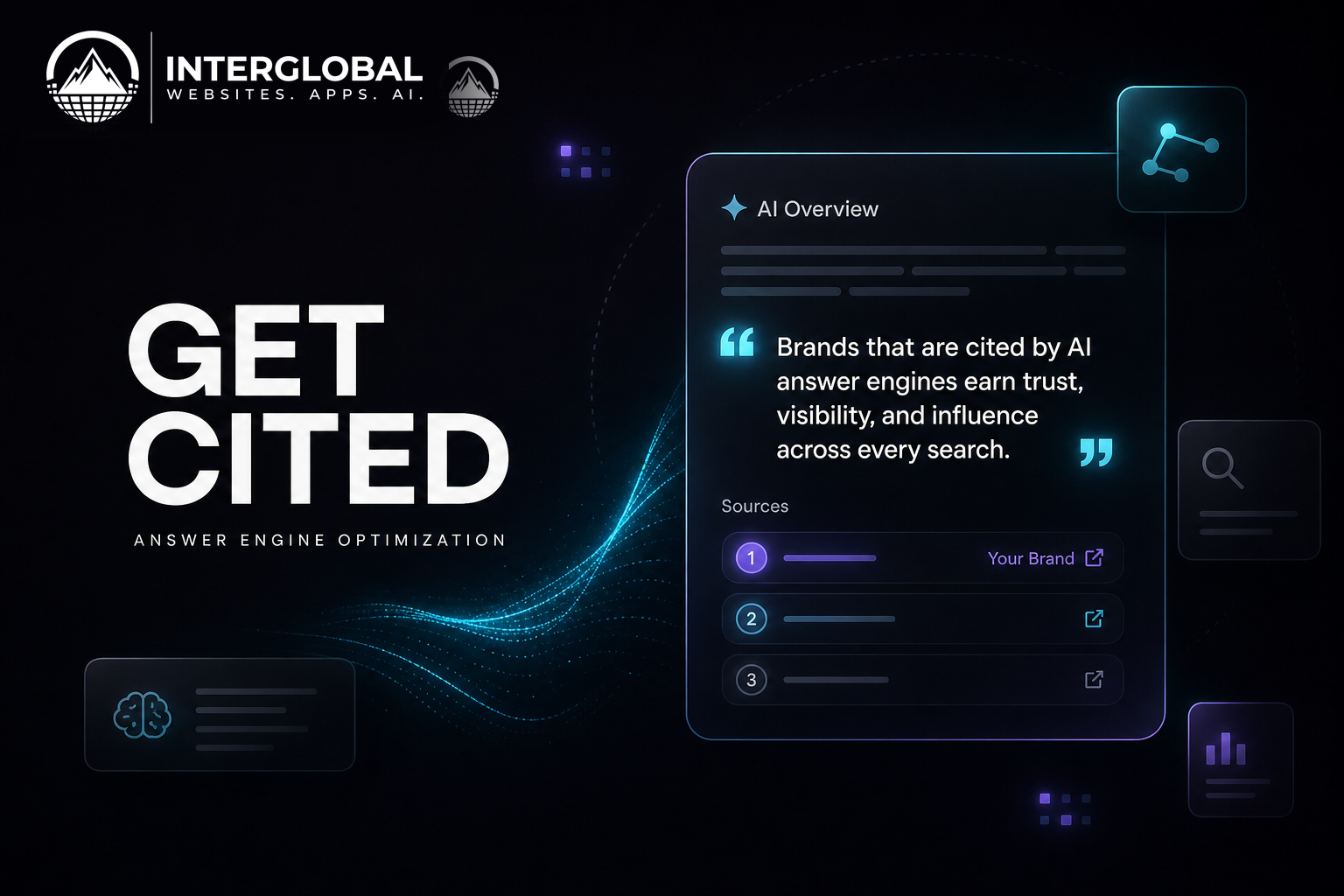
Blue-link rankings still drive traffic. They no longer monopolize demand. AI Overviews, AI Mode, ChatGPT with browsing, Perplexity, and enterprise copilots all compress research into a shortlist of named sources. Buyers often stop at the brief. That means citation share—how often you appear as a named source for high-intent prompts—is becoming as important as organic sessions.
Three structural shifts make AEO non-optional:
- Answer compression: Models prefer concise, sourced paragraphs over long marketing essays.
- Entity resolution: Systems match brands, products, people, and places; inconsistent naming kills trust.
- Evidence preference: Original data, methods, definitions, and first-hand process pages outrank recycled listicles.
If your content strategy still optimizes only for “rank #1 for keyword X,” you are optimizing yesterday’s interface. Rankings remain useful; citations decide who gets remembered inside the answer.
Consider the buyer journey for a complex purchase—software platform, agency partner, industrial system upgrade. Decision makers no longer open twenty tabs. They ask an answer engine for a shortlist, then click one or two cited sources to validate. Missing that shortlist is equivalent to missing the first sales conversation. AEO is how you earn that conversation before a human ever fills out a form.
AEO vs SEO vs GEO: Clear Boundaries
Language around generative search is noisy. Keep the distinctions clean:
| Discipline | Primary outcome | Core assets |
|---|---|---|
| SEO | Ranked links & organic traffic | Technical health, content depth, links |
| AEO | Named citations inside answers | Answer blocks, schema, entities, evidence |
| GEO / LLM visibility | Presence across generative platforms | Cross-engine consistency + distribution |
InterGlobal treats AEO as the operational core. SEO keeps you discoverable. GEO expands platform coverage. AEO decides whether the answer engine has a clean, citable packet of truth about your brand.
The Citation Architecture: Five Layers That Get You Quoted
Winning AI Mode citations is not a single tactic. It is a stack.
1. Answer-first page design
Open every priority page with a 40–80 word definition or decision answer. Place it above narrative storytelling. Models and scanners look for early, self-contained statements. Follow with supporting sections that expand—never bury the answer under brand poetry.
2. Extractable facts
Use concrete numbers, named methods, dated claims, and unambiguous definitions. Vague positioning (“we deliver transformative outcomes”) is nearly unquotable. Specifics (“we ship production Flutter MVPs with offline sync in 8–12 weeks for B2B operators”) give models something to lift.
3. Structure and schema
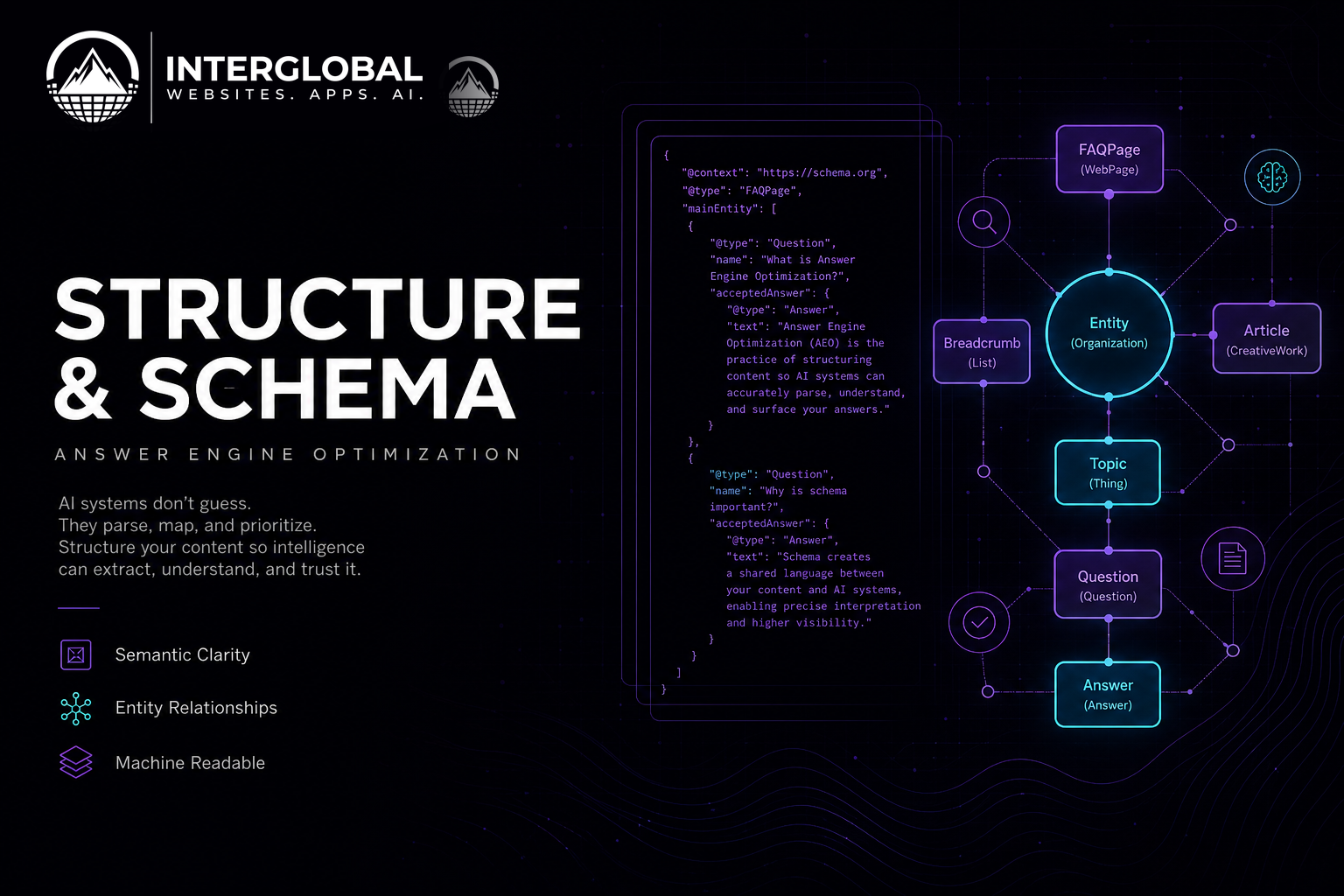
Headings must map to questions. Pair that with JSON-LD: Organization, WebSite, Article/BlogPosting, FAQPage, HowTo, Service, and Review where truthful. Schema is not a magic citation switch—it is a clarity amplifier for entity and claim mapping.
4. Entity consistency
One legal brand name, one primary domain, one consistent description of what you do. Align NAP-style signals, About copy, service taxonomy, and third-party profiles. Answer engines punish contradictory identity more harshly than humans do.
5. Corroboration and distribution
Primary content on your site is necessary; third-party corroboration is decisive. Case studies republished, expert quotes, partner pages, directory consistency, and original research citations create a mesh of trust. Models prefer claims that appear in more than one reputable context.
“AEO is not about writing for robots. It is about removing ambiguity so intelligent systems can attribute credit correctly.”
Content Patterns That Travel Into AI Answers
Not every format cites equally. Prioritize patterns that answer engines repeatedly harvest:
- Definition pages: “What is X?” with a crisp lead answer and boundaries (what it is / is not).
- Decision frameworks: comparison tables, “choose if / avoid if” rules, checklists.
- Process playbooks: numbered steps with prerequisites, outputs, and failure modes.
- Original benchmarks: even small proprietary datasets outperform generic advice.
- FAQ clusters: real buyer questions with direct answers—then depth below.
InterGlobal’s web design and Next.js website work increasingly includes AEO page architecture as a first-class deliverable: answer blocks, schema packages, and entity hygiene baked into launch—not bolted on after rankings stall.
Avoid thin “AI-written” filler that restates the same public consensus. Answer engines already know consensus. They reward pages that add a unique angle: your method, your constraints, your measured outcomes, your failure modes. Uniqueness plus clarity is the citation formula. Fluff is invisible.
Technical Foundations Answer Engines Still Require
AEO fails on a broken site. Before investing in citation content, confirm:
- Pages are crawlable without hostile bot walls for legitimate search/AI crawlers you intend to allow.
- Core content is in HTML text—not trapped exclusively in canvas, image, or client-only renders.
- Canonicals, hreflang (if multilingual), and internal links form a coherent graph.
- Performance is calm: answer extraction favors pages that load and parse cleanly.
- Author/publisher identity is visible and consistent with Organization schema.
For productized digital systems, pair AEO content with durable engineering. Our AI integrations and MVP development practices treat discoverability and structured data as product requirements—not marketing afterthoughts.
Building a Global Authority Mesh
Citations follow authority density. A single brilliant blog post rarely moves AI Mode alone. Authority is a mesh: owned media, earned mentions, product documentation, research, and proof assets that all describe the same entity.
Practical authority program for 2026:
- Own the definitions in your category with evergreen, updated playbooks.
- Publish proof: methods, teardown metrics, implementation notes, anonymized outcomes.
- Standardize identity across site, LinkedIn, directories, and partner pages.
- Seed corroboration through partnerships, guest expertise, and citation-worthy assets.
- Refresh cadence: update dates and facts quarterly so models see living sources.
How to Measure AEO Without Guesswork
Vanity metrics will mislead you. Build a citation dashboard:
- Prompt set: 25–50 buyer prompts per priority service; run monthly across Google AI Mode, ChatGPT, and Perplexity.
- Citation share: % of prompts where your brand is named or linked as a source.
- Share of voice vs rivals: who else appears in the same answers.
- Landing quality: when cited, does the destination match the claim?
- Entity health: consistency score across owned and third-party profiles.
Treat regression like product QA. If a refresh drops citation share, inspect whether you diluted the answer block, changed entity language, or removed schema. AEO is iterative systems work.
Also track assisted conversions: forms, booked calls, and demo requests that arrive from users who discovered you via an AI citation path—even when analytics attribution is imperfect. Combine qualitative prompt reviews with quantitative site outcomes so leadership sees AEO as revenue infrastructure, not a content hobby.
Key Takeaways
- AEO optimizes for citation inside answers—not only rankings.
- Answer-first copy, extractable facts, schema, and entity consistency form the core stack.
- Corroboration across the open web amplifies owned content.
- Measure citation share with a fixed prompt panel across major answer engines.
- Engineering + content must ship together; unreadable pages cannot be quoted.
90-Day InterGlobal AEO Playbook
Use this as an operating plan, not a slogan:
Days 1–30 — Foundation. Audit top 20 commercial pages for answer blocks, schema gaps, and entity drift. Fix technical crawl issues. Publish or rewrite three definition/decision pages for your highest-intent services.
Days 31–60 — Evidence. Ship one original asset (benchmark, method, or teardown). Align Organization schema and About messaging. Expand FAQ clusters tied to real sales questions.
Days 61–90 — Mesh & measure. Secure corroborating mentions. Stand up the monthly prompt panel. Reinvest in pages that earn citations; prune or merge pages that confuse entities.
Teams that want this executed end-to-end—content architecture, schema, site engineering, and AI product surfaces—can start with a focused engagement via contact. InterGlobal builds Digital Intelligence systems that are composed enough for executives and precise enough for machines.
Ready to become the source AI Mode cites? We design answer-first websites, schema packages, and authority systems that make your brand extractable and attributable.
Book an AEO Strategy Session →