What five jobs will AI not replace?
Quick answer: The question asks for five jobs AI will not replace. The evidence reviewed here does not support that kind of list. A job is a set of tasks, relationships, and responsibility. Tools can change some tasks. A person still owns the result and the review. The five roles below are examples of that distinction. They are not a promise that any job is immune to change.
If you run a business, the useful next step is a map of one workflow you actually operate. Name the task, the input, the output, the responsible person, and the review checkpoint. InterGlobal is a design and development studio in Dallas. This article does not provide nursing, electrical, teaching, counseling, or project-management services, and it does not promise a job, a wage, or a qualification.
What's in this article?
The poster, in motion
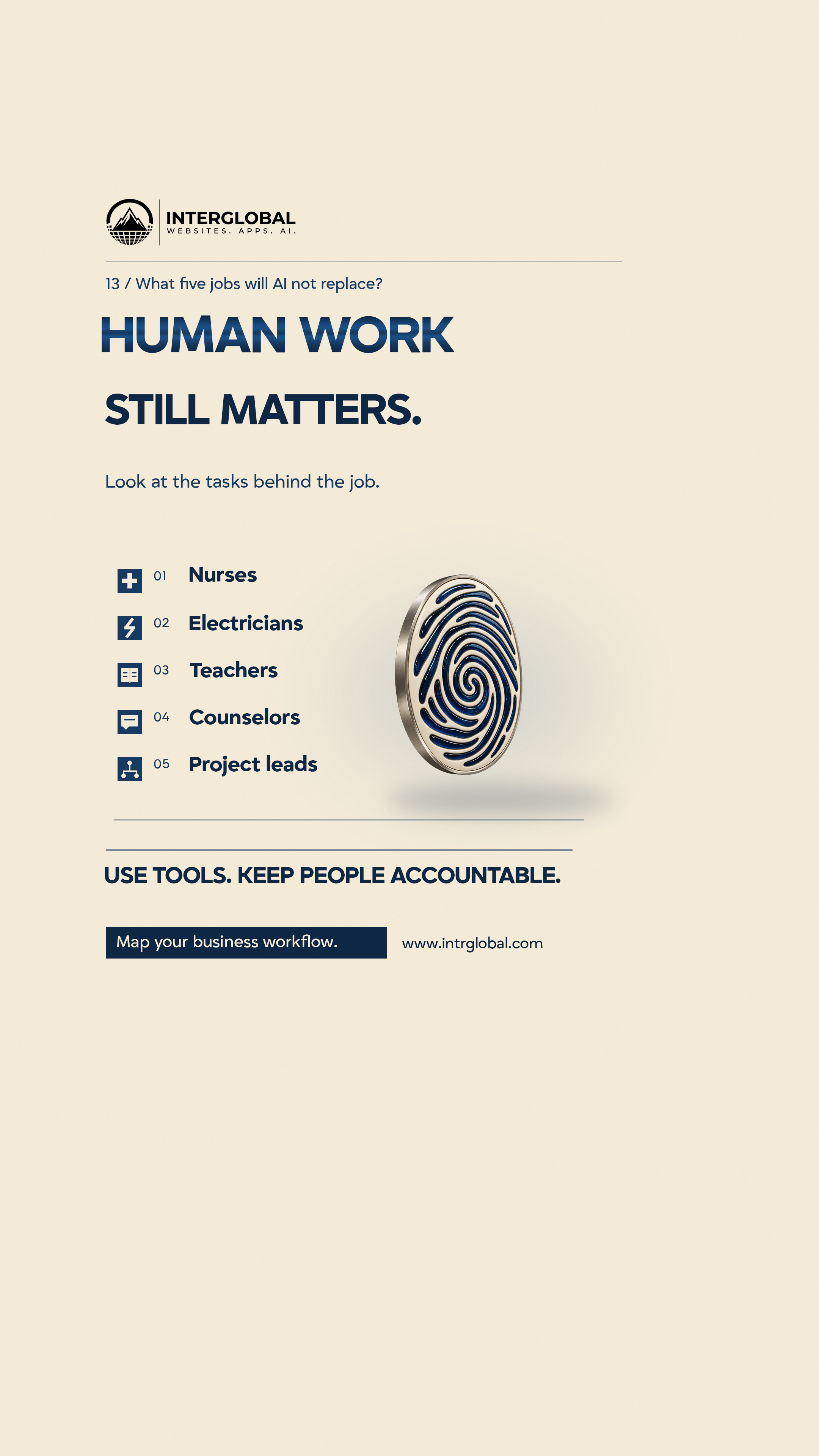
The square below plays once when it comes into view and pauses when it leaves the screen. Replay runs it again. If you prefer less motion, the finished poster stays in place and both links still work. The fingerprint mark is original symbolic artwork. It is not a record of a real person.
































Keep the question, and answer it narrowly
What five jobs will AI not replace? A title by itself is a poor answer. Registered nurses, electricians, elementary teachers, mental health counselors, and project management specialists all include work that a document, a calculation, or a generated reply does not finish. That observation is not the same as a guarantee. The shorthand on the poster is Nurses, Electricians, Teachers, Counselors, and Project leads. The headline is HUMAN WORK STILL MATTERS. The closing line is USE TOOLS. KEEP PEOPLE ACCOUNTABLE.
Use the roles as a way to look inside work, not as a ranking. Ask which part is a task a tool can prepare, which part depends on a person in a real situation, and who remains responsible when the result is wrong or incomplete.
What the ILO research measures
The International Labour Organization article How might generative AI impact different occupations?, published May 20, 2025, and reviewed on October 12, 2026, studies potential exposure to generative AI at the level of tasks. It separates that potential exposure from employment effects that have already been observed. The findings described there indicate that most occupations still include tasks that need human input, and that transformation is the most likely impact. The article also treats the future as uncertain.
That is a statement about generative-AI exposure. It is not a count of jobs already lost, and it is not a prediction about robotics or every kind of AI. It does not name five occupations that will never change.
Five roles, described as duties
The Bureau of Labor Statistics profiles below describe what people in these occupations do. A duty list is not a finding that the occupation is protected from technology. These five are InterGlobal editorial examples. They are not an ILO ranking and they are not a BLS ranking.
Registered nurses
The BLS profile of registered nurses describes people who provide and coordinate patient care, educate people about health conditions, and support patients and families. On a workflow map, the care and the next decision stay with a responsible person. A prepared note can be an input. It is not the whole duty.
Electricians
The BLS profile of electricians describes people who install, maintain, and repair electrical systems, including inspecting components and identifying problems with testing devices. On a workflow map, the checkpoint is the system in the actual place. A written procedure can be an input. It is not the inspection.
Elementary teachers
The BLS profile of kindergarten and elementary school teachers describes people who teach basic subjects and help students understand and apply concepts, including work with students, lessons, and the classroom. On a workflow map, a prepared resource is an input. The responsible person is the one who sees whether a student understands.
Mental health counselors
The BLS profile of substance abuse, behavioral disorder, and mental health counselors describes people who advise and support people on issues in those fields. On a workflow map, context and the responsible person belong beside any output. This page is not counseling advice.
Project management specialists
The BLS profile of project management specialists describes people who coordinate a project's budget, schedule, and other details, guide technical staff, and sometimes serve as the client contact. On a workflow map, a schedule can be an output. The responsible person is the one who confirms the commitment and the review.
Separate the finding from our reading
The ILO finding, as published, is about potential generative-AI exposure and the likelihood of transformation, with human input remaining in most occupations. The BLS finding, for each profile, is a description of duties. Neither source publishes these five titles as jobs that AI will not replace.
Our reading is editorial. The shared pattern is task-level. In nursing, the task may be a note, while the responsibility is care and coordination. In electrical work, the task may be a procedure, while the responsibility is the system on site. In teaching, the task may be a lesson resource, while the responsibility is the student's understanding. In counseling, the task may be information, while the responsibility is support in context. In project leadership, the task may be a schedule, while the responsibility is the commitment between people. A tool can sit inside the task. It does not automatically become the responsible person.
Map one business workflow
You do not need to copy these occupations into your company. Use them as a pattern for a process you already run. Pick one bounded workflow, such as answering an inquiry, preparing a quote, updating a service page, or handing work from one person to another.
Write five facts, and leave a fact blank when you do not know it yet:
- Task. What has to be finished?
- Input. What information, file, or condition does the work start from?
- Output. What can another person review?
- Responsible person. Who owns the result if it is wrong or incomplete?
- Review checkpoint. Where does a person accept, correct, or stop the work?
A tool can draft, sort, calculate, or remind. Put that help in the input or the task, not in the name of the responsible person, unless a specific person has accepted that role. If a checkpoint is missing, the map has found a gap. Do not fill the gap with a guess about the future of a profession.
This is the same distinction the poster is making. Use tools. Keep a person accountable for the result. The sheet below is empty so the answers come from your process, not from an example we invented.
Fill the empty responsibility sheet
Leave every cell blank until you have looked at the workflow. Do not enter a salary, a forecast, or a job title as a substitute for the five facts.
| Task | |
|---|---|
| Input | |
| Output | |
| Responsible person | |
| Review checkpoint |
Bring the map to a conversation about a website, an application, or a business system that has to support the workflow. The sheet is a discussion aid. It is not a hiring test, a career plan, or instructions for clinical, classroom, electrical, or counseling practice.
Map your business workflow
Bring one process and the responsibilities you want to make clearer. InterGlobal can talk through the digital work that supports it. The conversation does not promise a job, a wage, or a result for a profession outside this studio's work.
Use tools. Keep the owner clear. Bring one workflow and the person who reviews it.
Map your business workflowThe studio site is www.intrglobal.com.
Key takeaways
- What five jobs will AI not replace? These five roles are examples of tasks and responsibility, not a list of jobs immune to change.
- The ILO May 2025 analysis measures potential generative-AI exposure. It is not observed displacement, and it is not a forecast for every kind of AI.
- Each BLS profile cited here describes duties. It does not establish that the occupation is protected.
- Map a real workflow with a task, an input, an output, a responsible person, and a review checkpoint.
Questions people ask
What five jobs will AI not replace?
This article does not name five jobs that are immune to change. It uses registered nurses, electricians, elementary teachers, mental health counselors, and project management specialists as examples of tasks, relationships, and responsibility. A tool can change a task. A person still needs to own the result.
Does the ILO say these jobs are safe?
No. The May 2025 ILO article studies potential exposure to generative AI at task level. It distinguishes that exposure from observed employment effects, notes that human input remains in most occupations, and treats transformation as the likely impact. It does not guarantee the future of any occupation.
What do the BLS profiles show?
They describe duties: care and coordination, electrical work on site, teaching and application, advice and support, and coordination of budget, schedule, and people. Those descriptions are not a ranking and not a finding of immunity. They were reviewed on October 12, 2026.
What does Map your business workflow do?
It opens the booking section at https://intrglobal.com/#book so a business can talk about a website, application, or system that supports a real workflow. www.intrglobal.com opens the studio site. InterGlobal is not offering nursing, electrical, teaching, counseling, or project-management services through this article.