Is AI replacing web designers?
Quick answer: AI can help produce a website. It does not decide whether the result serves your customer. Name the purpose, test the experience, and check the proof. Give each important decision an owner.
A business owner may see a generated layout, draft copy, or code earlier in a project. The useful question is who decides whether that output fits the business and works when someone uses it. Those responsibilities matter whether the first draft comes from an AI tool, a template, or a designer's own work.
This article is about judgment. It is not a ranking of AI models, and it is not a forecast that one tool will replace the profession. There is no employment guarantee here, and no claim that AI caused a change in hiring.
What's in this article?
The poster, in motion
The square below plays once when it comes into view. Replay runs it again. If you prefer less motion, the finished poster stays in place and both links still work.
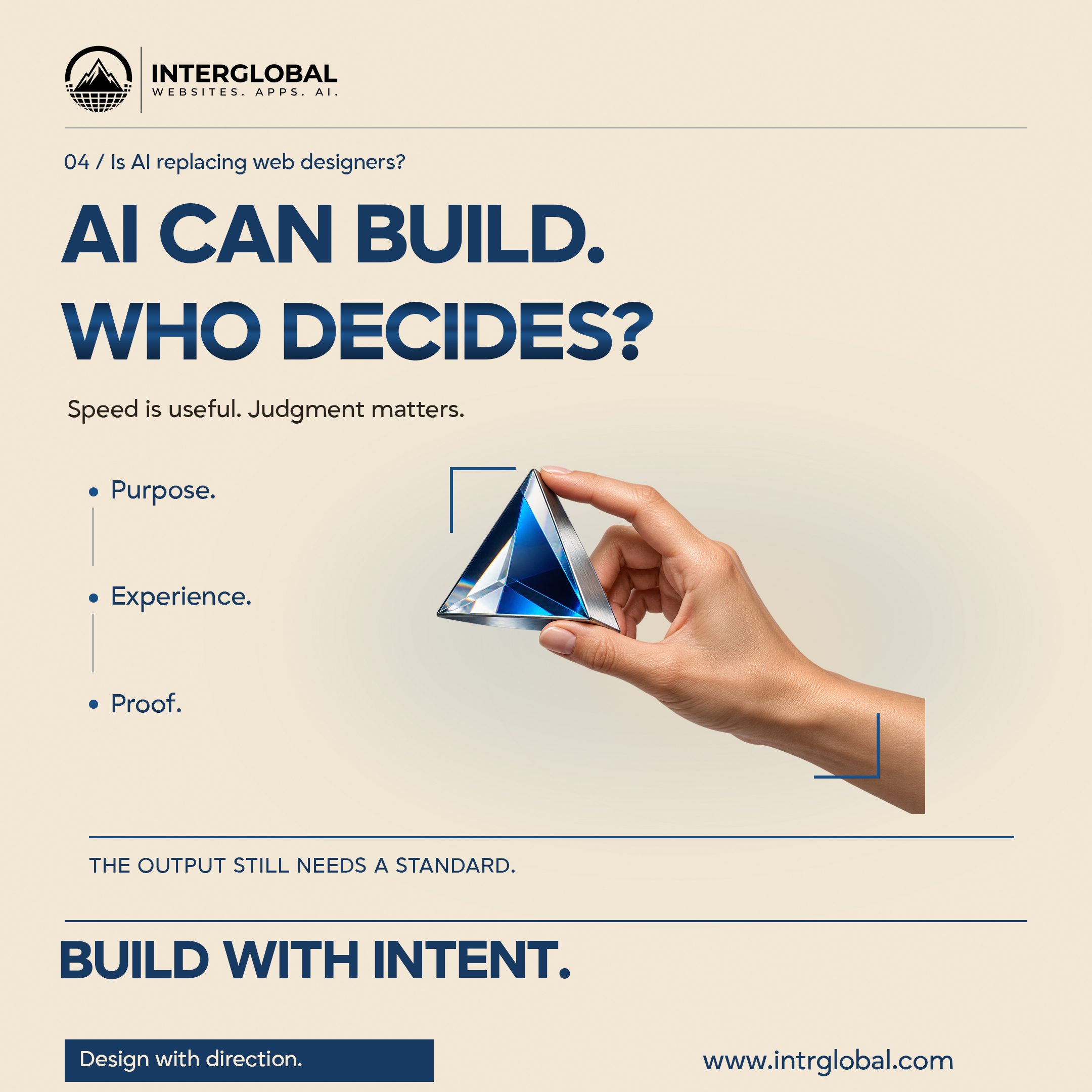






























A profession contains more than producing a screen
The U.S. Bureau of Labor Statistics describes this work as developing and testing layouts, functions, and navigation for usability. Its current outlook projects combined employment of web developers and digital designers to grow five percent from 2025 to 2035. That national projection does not guarantee an individual job, describe the Dallas market, or measure how much of a task AI will perform. It is not evidence that AI caused the projection. It does show why a claim that the entire occupation has already disappeared needs more than a convincing demo. BLS: Web Developers and Digital Designers.
For the business hiring a provider, the important part is the work behind the screen. Someone has to understand the offer, decide what visitors need, choose a useful structure, review the information, and test the customer journey. A production tool can be part of that process. The agreement still needs to say who is accountable for the finished website.
Start with purpose before asking for output
Write down the customer task. A visitor might need to request a quote, compare services, book an appointment, or find accurate information before calling. Name the audience and the information required to support that action.
That brief gives the designer, and any tools they use, a standard. Without it, a polished page can make the wrong idea look convincing. A visual direction that fits a luxury shop may not suit a local service business whose visitors need a phone number and a straightforward explanation.
Ask the provider to explain the major design choices in plain language. Why is this information first? Why is this the main action? What question is this section answering? The answers should connect to the customer and the business, rather than relying on the name of a tool.
Use AI output as material to review
A first draft creates something to discuss. It does not establish that every statement is accurate or every function is ready. Your team should approve the service details, examples, and claims that represent the business.
Google's guidance on generative AI content emphasizes accuracy, quality, and relevance, and calls for fact-checking and review before publication. It also warns that producing many pages without adding value for users may fall under its scaled-content-abuse policy. This is guidance about useful web content. It is not an automatic ban on AI-assisted work, and it is not a promise of rankings. Google Search Central: Guidance on Generative AI Content.
For a Dallas business, the review might include the services you actually offer, the area you serve, the images you have permission to use, and the process you can deliver. Do not publish invented testimonials, certifications, client stories, or performance figures because they make a draft feel more complete. Correct a missing detail or remove it until the business can substantiate it.
Experience needs testing with real tasks
Ask to see the path a customer will take on a phone. Start from the page they are likely to open, read the relevant information, and try the action. A form should submit successfully, explain a problem clearly, and reach the person responsible for answering it. A booking link should lead to the intended process.
Check navigation, readable type, and keyboard access. Review how the site behaves with longer text and different screen sizes. An animation can explain an idea, but visitors should still be able to read and act with reduced motion, or when that effect does not load.
These are concrete checks a provider can demonstrate. They are more useful than a vague claim that a website is AI-powered or custom without explaining what that means for your business.
Assign the decision, review, and handover
A clear proposal names the person who approves the content, the person who checks the implementation, and the person who publishes the agreed work. It also explains what you receive at handover and who maintains the site afterwards.
If AI tools are involved, ask how outputs are reviewed and how your materials are handled. Keep confidential account access and sensitive customer information within the approved process. You do not need every detail of the production machinery to judge the service. You do need clarity about responsibilities, rights, and the finished deliverable.
Agree on review rounds and how changes are approved. A prompt can produce another variation, but the business still needs a coherent direction. Decide which feedback changes the goal and which feedback improves the chosen solution, then record the approved result.
A practical review standard
Use three headings: purpose, experience, and proof. Under purpose, ask whether the page explains the actual offer and supports the main customer task. Under experience, test whether a visitor can understand the page and complete the next step on a phone or with a keyboard. Under proof, check the business claims, the functioning action, and the access you receive at handover.
For each area, write the decision owner, what will be demonstrated, and what remains unresolved. A provider can use different tools and still meet that standard. If nobody owns an important check, resolve that gap before publication.
| Area | Decision owner | Demonstration | Unresolved |
|---|---|---|---|
| Purpose | |||
| Experience | |||
| Proof |
Fill the table with your project. Leave a cell empty until you know the answer. The sheet does not calculate a score, and it does not replace the agreement.
Choose a process you can assess
Avoid treating an AI demo as proof of a finished project or a prediction about every designer's future. Evaluate the work being offered: how the provider understands your business, develops a direction, reviews the output, and proves the customer journey works.
The right scope might be a focused improvement, a new design, or a larger build. The decision should follow the task your business needs to solve. Speed helps when it moves an appropriate idea forward and leaves time for careful review.
Design with direction at InterGlobal
Bring your current website, the customer action you want to support, and the questions you want the project to answer. InterGlobal can help turn that into a brief with a clear direction and a reviewable result. Visit www.intrglobal.com.
Key takeaways
- Ask who owns the decisions, not only how fast a first screen appears.
- The BLS five percent outlook for 2025 to 2035 is a national projection, not a job guarantee and not an AI-caused result.
- Google asks for accurate, useful, reviewed content. That guidance is not a ban and not a ranking promise.
- Purpose, experience, and proof need an owner, a demonstration, and a note of what is still unresolved.
Questions people ask
Is AI replacing web designers?
A tool can help produce layouts, copy, or code. It does not by itself decide whether the website serves the customer. Judge the purpose, the experience, and the proof, and name who is accountable.
Does the five percent BLS projection mean AI is growing the field?
No. The Bureau of Labor Statistics projects combined employment of web developers and digital designers to grow five percent from 2025 to 2035. That figure does not measure AI's share of the work, and it does not guarantee a job.
Does Google ban AI-assisted pages?
Google's guidance calls for accuracy, quality, relevance, and review. Pages produced at scale without value for users may violate its spam policy. The guidance is not an automatic ban and not a promise that AI content will rank.
What does Design with direction do?
It opens the booking section at https://intrglobal.com/#book. www.intrglobal.com opens the studio site.