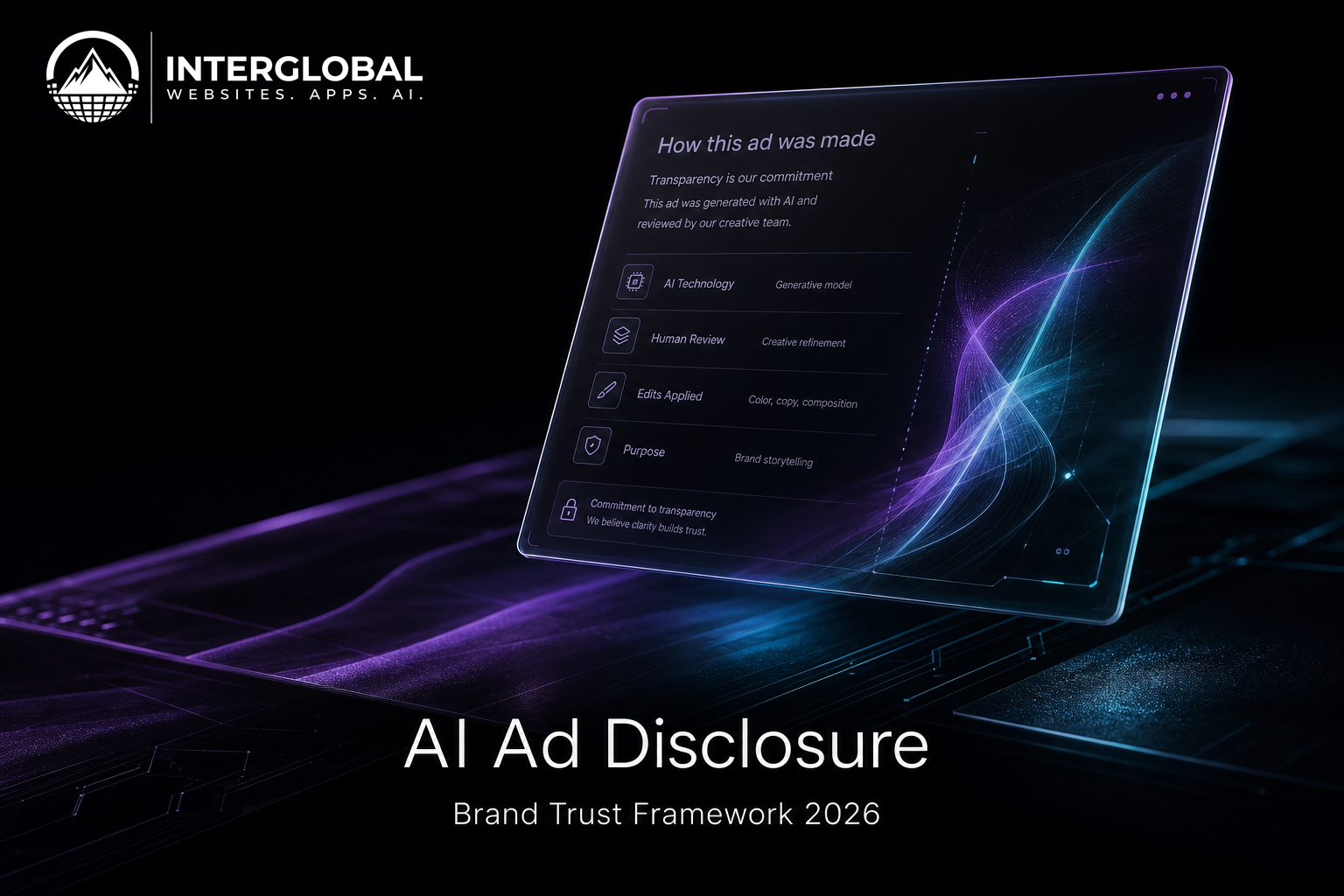
AI ad disclosure is no longer a legal footnote—it is a brand-trust operating system. InterGlobal Digital Intelligence runs three layers: clear disclosure design, creative governance with human sign-off, and trust-aware measurement that protects ROAS while reducing disapproval and reputation risk.
Why July 2026 Made AI Ad Disclosure Unavoidable
Summer 2026 did not invent AI advertising. It made invisible AI advertising untenable. Across major ad platforms, policy updates, and regulator guidance, the market converged on a simple expectation: if a consumer cannot tell whether a face, voice, product demo, or testimonial was machine-made, the brand owns the risk.
That risk is commercial, not just legal. Disapproved ads stall campaigns. Misleading synthetic testimonials invite chargebacks and complaints. A single “was that AI?” pile-on can erase months of paid acquisition efficiency. The brands that treat disclosure as a checkbox will keep shipping fragile creative. The brands that treat disclosure as a trust system will keep shipping scale.
This guide is news-tied to the July 2026 disclosure acceleration—and deliberately evergreen. Platform labels will keep changing. Your framework should not. InterGlobal Digital Intelligence builds disclosure into creative ops so marketing teams can move fast without gambling the brand.
If your current workflow is “generate ten variants, launch the winners, fix policy issues later,” you are optimizing for short-term throughput. The July 2026 environment rewards the opposite posture: generate with constraints, ship with provenance, and scale only what can survive review and public scrutiny. That is how AI advertising becomes infrastructure instead of a liability cycle.
Disclosure Is Not Trust—But Trust Starts With Disclosure
A label alone does not make an ad trustworthy. Consumers still judge offer clarity, proof quality, brand consistency, and whether the creative feels manipulative. Disclosure is the entry fee. Trust is the compounding return.
Think of disclosure as the difference between a transparent salesperson and a scripted illusion. When shoppers know AI helped produce a scene, they evaluate the claim—not the sleight of hand. When they discover the sleight of hand later, they punish the brand.
For performance marketers, that distinction matters. Opaque AI creative can look efficient in week one and toxic in week six. Transparent AI creative may convert slightly differently—and then outperform because it avoids policy friction, comment-section distrust, and creative churn after forced remakes.

The InterGlobal Brand Trust Framework for AI Ads
InterGlobal Digital Intelligence structures AI advertising around three durable layers. Use them whether you run Meta, Google, LinkedIn, TikTok, CTV, or a private-marketplace mix.
Layer 1 — Disclosure Design
Define what must be labeled, where the label appears, and how copy states AI involvement without burying the claim.
Layer 2 — Creative Governance
Control generation tools, claim libraries, human review gates, and provenance logs before anything goes live.
Layer 3 — Trust Measurement
Track disapprovals, complaint rate, brand-search lift, and creative longevity beside CPA and ROAS.
This is not a “make prettier ads” playbook. It is not a color-trend guide. It is the operating system that keeps AI creative deployable when scrutiny rises.
Layer 1: Disclosure Design That Consumers Actually Notice
Weak disclosure fails twice: platforms reject it as insufficient, and consumers miss it entirely. Strong disclosure is designed into the creative—not bolted on as a 6-point footnote.
Write a risk ladder for every asset class:
- High risk: synthetic humans, cloned voices, fabricated social proof, AI medical/financial claims, demos that imply live product footage.
- Medium risk: AI-extended product scenes, heavily altered environments, AI-written scripts delivered by real talent.
- Lower risk: layout assistance, background cleanup, translation, crop/resizing with no claim changes.
High-risk assets get explicit on-creative labels plus landing-page clarity. Medium-risk assets get contextual disclosure and documented review. Lower-risk assets still get provenance logging so your team can answer “was AI involved?” without a scavenger hunt.
Place disclosure where attention already lands—near the face, CTA, or first spoken line—not only in a corner of the last frame. If a viewer can miss it while absorbing the offer, it is not working disclosure.
Language matters. Prefer plain statements: “AI-generated imagery,” “AI-assisted creative,” “synthetic voice with human-reviewed script.” Avoid coy phrases that feel like evasion. Clarity reduces comment hostility and speeds platform review.
Layer 2: Creative Governance Before the Ad Ever Leaves Staging
Most AI ad failures are process failures. Someone generated a testimonial face, someone else shipped it, and nobody owned the claim chain. Governance fixes that without killing speed.

Install four non-negotiable controls:
- Approved tool stack. Only generate ads inside tools your brand can audit, export, and log.
- Claim library. AI may remix approved facts; it may not invent outcomes, prices, certifications, or customer quotes.
- Human sign-off gate. A named reviewer approves high-risk creative before media spend. No anonymous “looks fine.”
- Provenance packet. Store prompt notes, source assets, disclosure version, reviewer, and ship date with the ad ID.
For regulated or high-stakes categories—home services with guarantees, health-adjacent offers, finance, education—treat AI like a junior copywriter with no legal authority. It drafts. Humans certify.
Governance also protects speed. When reviewers know the claim library and disclosure templates in advance, they approve faster than teams that invent policy language under a disapproval deadline. The goal is not more meetings. The goal is fewer emergency remakes, cleaner creative handoffs, and a shared vocabulary between media, creative, and counsel.
Never let AI invent customers, ratings, or “before/after” outcomes. Synthetic social proof is the fastest path from clever creative to trust collapse—and often to platform or regulatory trouble.
Layer 3: Measure Trust Like You Measure ROAS
If your dashboard only shows CPA, you are flying half-blind. Trust friction shows up first as disapproval rate, creative kill-rate, comment sentiment, refund spikes, and brand-search softness. Capture those signals before the board asks why paid efficiency “suddenly” worsened.

Minimum trust scorecard for AI ads:
| Signal | What it reveals | Action trigger |
|---|---|---|
| Ad disapproval / limited delivery | Policy or disclosure gap | Pause, remake with clearer label + proof |
| Negative comment rate on AI labels | Tone or claim mismatch | Rewrite disclosure + strengthen evidence |
| Creative lifespan (days live) | Fatigue or trust decay | Rotate variants without inventing new claims |
| Brand search + direct lift | Whether ads build equity | Protect winners; retire clever-but-hollow AI |
| Complaint / refund association | Expectation mismatch | Audit landing claims vs. creative promise |
InterGlobal Digital Intelligence teams score creative on both efficiency and trust durability. A cheaper CPA that burns brand search is not a win—it is deferred debt.
Channel Playbook: Where Disclosure Friction Hits Hardest
Social and short-form video: Faces and voices drive the risk. If a person appears who does not exist—or a voice is cloned—disclose early and avoid fabricated testimonials. Keep offer claims identical to the landing page.
Search and Performance Max-style inventory: AI may help assets scale, but landing-page honesty still decides conversion quality. Disclosure on creative does not excuse mismatched guarantees below the fold.
LinkedIn and B2B: Buyers are skeptical of synthetic executives and fake case-study quotes. Use real customers, real logos you have rights to, and AI only for drafting or visual polish with clear governance.
CTV / connected TV: Higher production polish raises suspicion when something feels “too perfect.” Pair AI-assisted scenes with verifiable brand marks, real product shots, and spoken clarity when synthetic elements are material.
Key Insight
The winners of the AI ad era will not be the brands that hide the machine. They will be the brands that make the machine accountable—then out-execute competitors still stuck in opaque generation.
90-Day Rollout: From Panic Compliance to Operating System
Days 1–14 — Inventory. Export every live AI-assisted asset. Tag risk tier, disclosure status, claim source, and owner. Kill anything with invented social proof immediately.
Days 15–45 — Systemize. Publish disclosure language standards, reviewer SLAs, and a provenance template. Retrain creative and media buyers on the risk ladder. Rebuild high-risk winners with compliant disclosure instead of pausing growth forever.
Days 46–90 — Instrument. Add trust metrics to weekly reporting. A/B disclosure placements only after claims are honest. Document what platforms accepted so legal and marketing share one source of truth.
By day 90 you should have fewer emergency remakes, cleaner reviews, and a creative team that can ship AI volume without gambling reputation.
Key Takeaways
- July 2026 accelerated AI ad disclosure—but the durable edge is an evergreen trust framework.
- Disclosure without proof is theater; proof without disclosure is a future crisis.
- Govern tools, claims, human review, and provenance before media spend scales.
- Measure trust friction beside ROAS or you will optimize into brand damage.
- InterGlobal Digital Intelligence turns compliance pressure into a competitive operating system.
Need an AI ad trust system—not another one-off creative sprint? InterGlobal Digital Intelligence builds disclosure standards, creative governance, and measurement dashboards that keep paid media scalable under 2026 scrutiny.
Talk to InterGlobal →